Last updated November 2026
Creator marketing for ecommerce brands means turning the people who post about your products into a channel that delivers three things: content you can run as ads, referrals that bring in new customers, and sales tracked to each creator. Those creators can be your own customers, fans already tagging you, ambassadors and new creators who fit your audience.
This guide shows how DTC and ecommerce brands build that channel, with examples from Roster customers Caraway, GreenStalk Garden, GoBe Kids and VOORAY, and benchmarks from live programs in Ambassador Marketing Benchmarks 2026.
What creator marketing delivers for an ecommerce brand
Most advice treats creator marketing as paying for posts and reach. For an ecommerce brand, the better test is what the program produces every month:
Content
A steady supply of UGC posts with usage rights, so the best of it can run as Meta partnership ads and TikTok Spark Ads, in email and on your product pages.
Referrals
New customers who arrive through a creator's code or link, recommended by someone they already trust.
Sales
Revenue tied to each creator, so you know who to reward, who to brief again and where to put more budget.
A channel that compounds
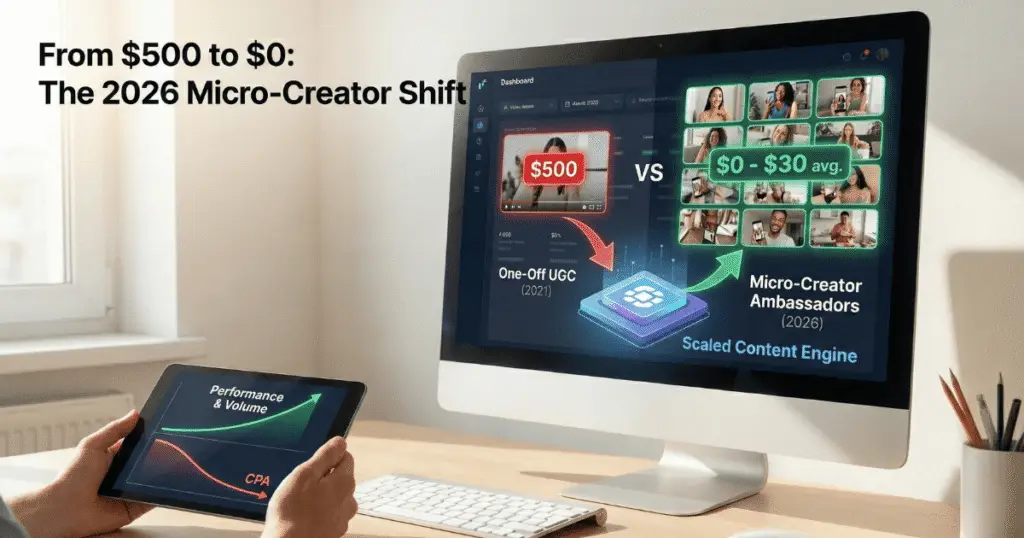
Creators who keep posting month after month, instead of a one-off sponsored post that stops working when the campaign ends.
Why brands are investing in creators now
Independent research points the same way: budgets are moving to creators, and shoppers are leaning on real people over polished brand content.
| Finding | Source |
|---|---|
| US creator ad spend projected to reach $37B in 2025, up 26% year over year and about 4x faster than total media. 48% of ad spenders call creators a "must buy". | IAB, 2025 Creator Economy Ad Spend & Strategy Report |
| Driving online sales and conversions is among the top four goals brands set for creator campaigns (32%). | IAB, November 2025 |
| US influencer marketing spend is forecast to grow 15.7% in 2026, and micro- and nano-influencers will take 45.5% of it. | EMARKETER, January 2026 and Creator Economy 2026 |
| 43% of US consumers say they now rely more on real people for shopping recommendations because of AI-generated content, while 35% rely on influencers less. | Gartner, September 2026 |
| 88% of people trust recommendations from people they know more than any other channel. | Nielsen Trust in Advertising |
Checked November 7, 2026 on each source's own page.
For an ecommerce brand, the takeaway is practical. The people with the most credibility are the closest to your product: customers and smaller creators who already use it. A program that turns them into content, referrals and sales is where that trust becomes revenue.
What the strongest programs achieve
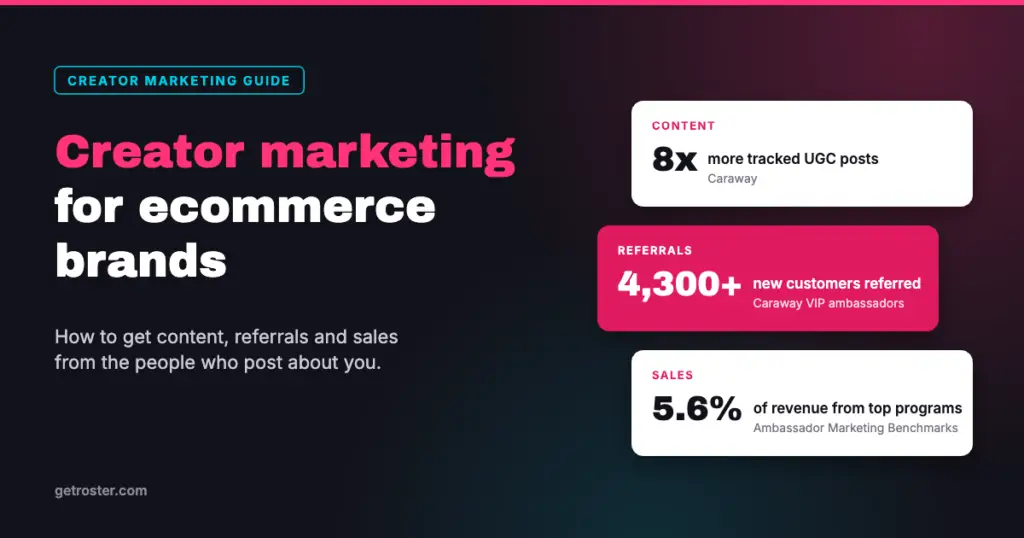
The gap between an average program and a strong one is large, and it is not about brand size. Ambassador Marketing Benchmarks 2026 measured established programs at DTC and ecommerce brands doing $5M to $25M a year:
| Monthly, per program | Baseline program | Strongest programs |
|---|---|---|
| Referred revenue as a share of brand revenue | 0.88% | 5.58% |
| Referred revenue per active member | $20 | $63 |
| Instagram posts per 100 active members | 10 | 38 |
| Members active in the last 30 days | 80% | 92% |
Source: Ambassador Marketing Benchmarks 2026, live programs on Roster, February to July 2026. Strongest programs are the 75th-percentile program in the same revenue band.
On a $25M brand, 5.58% is about $1.4M a year in referred revenue, against about $220,000 for the baseline program. The same members who drive those sales also produce almost four times as much content. Both outcomes come from how the program is run, which is the rest of this guide.
Start with the creators closest to your brand
The most reliable creators for an ecommerce brand are the people who already buy from you. They are easier to recruit, more credible on camera and far less likely to take a gift and disappear. Widen from there in rings:
- Customers invited after they buy, through email and a branded application form
- Fans already posting about you, found through social listening
- Ambassadors who join a formal program with ongoing rewards. Brand ambassador programs
- New creators who fit your audience, found through Creator Discovery on Instagram and TikTok and invited with product
GreenStalk Garden built its program on gardeners who already own its planter. Ambassador referrals now drive 49% of its total online revenue and 39% of its new customers. GoBe Kids, a two-person company, went from 10 mentions to more than 550 ambassadors and grew from 9,000 to 40,000 customers in 12 months, running the program in two to five hours a week.
Outcome 1: content you can run as ads
Creator content is only an asset if you can use it. That means capturing every post, recording usage rights per creator and moving the best posts into paid media quickly.
- Collect every post in a social feed instead of screenshots and spreadsheets
- Attach a brief and usage rights to UGC campaigns so content is cleared before it is posted
- Run winners as Meta partnership ads and TikTok Spark Ads from the creator's own handle, with permission tracked
- Reward posting, not only sales, so creators keep producing
Caraway rebuilt its program around gamification and went from about 250 to about 2,100 tracked ambassador posts a month, 8x more UGC, which now feeds its paid and organic social.
Why creator content works better from the creator's own handle
Licensing UGC lets you run it as a normal brand ad. Running it as a partnership ad from the creator's own account, with their name on it, is what each platform reports performs best:
| Platform and format | Reported result | Source |
|---|---|---|
| Meta partnership ads | 19% lower acquisition costs and 71% higher brand intent lift when added to a brand's usual campaigns; 25% better click-through rate in Reels campaigns | Meta for Business |
| Meta: partnership ads vs the same UGC licensed and run from the brand account | 19% higher click-through rate, 10% higher conversion rate and 5% lower cost per acquisition, across $130M in spend and 137 brands | Agentio study, reported by Net Influencer, August 2026 |
| TikTok Spark Ads | 43% higher conversion rate, 142% higher engagement rate and 4% lower CPM than non-Spark ads | TikTok Ads Manager help |
| TikTok creator ads | 70% higher click-through rate and 159% higher engagement rate than non-creator ads at the same CPM | TikTok for Business, November 2025 |
| YouTube creator partnerships | Advertisers who promoted creator-led videos on YouTube Shorts saw an average 30% increase in conversion lift | YouTube Official Blog, March 2026 |
Results reported by each platform or study; checked November 7, 2026. Your results will vary by product, audience and creative.
The pattern is the same on every platform: an ad that comes from a real person's account reads as a recommendation, not an ad. That is why recording usage rights and creator permission for every post matters. It is what lets your paid team move fast when a post starts working.
Outcome 2: referrals that bring in new customers
Every creator needs a personal code and link, and the program needs to know which orders came from new customers. That is how you separate a creator who sells to existing buyers from one who grows the customer base.
- Give every creator leak-resistant codes and referral links so codes do not spread to coupon sites
- Track new versus returning customers on referred orders
- Reward referrals of new customers more than repeat purchases
In 2025, Caraway's VIP ambassador group alone referred more than 4,300 new customers, with an 8% click-to-order conversion rate on about 73,000 referral clicks. At GreenStalk, referred orders carry a 15% higher average order value than non-referred orders.
Outcome 3: sales tracked to every creator
When every order is tied to a creator in the same Shopify store as the rest of the business, creator revenue is counted the same way as any other channel, and decisions get easier: who to reward, who to brief, who to amplify.
Caraway's VIP group drove $2.1M in referred revenue in 2025. VOORAY runs three separate programs for trainers, customers and creators with larger audiences, and measuring them separately showed which relationships produced revenue: $325,000 in additional revenue and a 31x return.
How to pay creators
Strong programs pay for the work as well as the sale. GreenStalk Garden's turning point was replacing a commission-only model with action-based incentives that reward posting and engagement.
| Reward | How it works | What it drives |
|---|---|---|
| Commission | A percentage of each sale from the creator's code or link | Referrals and sales |
| Cash rewards | A fixed bonus for an action, such as a post or a milestone | Content and activity |
| Flat fee | A set amount for specific content | Guaranteed content for launches and ads |
| Product gifting | Welcome gifts, launches and one-off drops | Recruiting and early content |
| Points, milestones and leaderboards | Points for every action that unlock tiers and rewards | Members who stay active |
Whatever the mix, check what your platform takes on top. Some charge a percentage of creator-driven sales or a fee on the money you deposit to pay creators, which grows as the program works. Roster is one flat monthly price and takes no percentage of your sales or creator payouts.
What to measure
- Referred revenue as a share of brand revenue, compared with the benchmarks above
- Referred revenue per active member, which shows whether activity turns into sales
- New customers referred and their average order value
- UGC posts per 100 active members, and how many have usage rights
- Content amplified: the share of approved posts that actually run as ads, and how they perform
- Active members in the last 30 days, not only total sign-ups
How to start
- Pick the first outcome. Content for ads, referred revenue or a product launch.
- Recruit from your customers first. Invite recent buyers and fans already posting.
- Set rewards for actions and sales. A commission plus a cash reward or product for each post is enough to start.
- Give every creator a code and link so every order is attributed.
- Capture content with usage rights as part of joining the program.
- Amplify and widen. Run the best posts as partnership ads, then add new creators through Creator Discovery.
Mistakes that hold creator programs back
- Paying a platform a percentage of creator sales or payouts, so cost grows with success
- Renting creators from a marketplace that restricts working with them directly
- Approving content that never runs as an ad
- Rewarding only sales, so members stop posting when they are not selling
- Measuring sign-ups instead of active members and referred revenue
What to look for in a platform
- Recruiting from your own customers, plus Creator Discovery on Instagram and TikTok
- Product gifting with no campaign required
- Usage rights recorded per creator
- Meta partnership ads and TikTok Spark Ads tracked next to the creator
- Codes, links, sales attribution and automated payouts
- Points, milestones, leaderboards and cash rewards
- Flat pricing with no percentage of sales or creator payouts
Roster is the creator marketing platform for DTC and ecommerce brands with all of these on one flat monthly price. Compare it with Aspire, GRIN, Upfluence, ShopMy and other platforms.
Frequently asked questions
What is creator marketing for ecommerce brands?
It is turning customers, fans, ambassadors and creators who post about your products into a channel that delivers content you can run as ads, referrals that bring in new customers, and sales tracked to each creator.
How is creator marketing different from influencer marketing?
Influencer marketing usually pays for posts and reach, one campaign at a time. Creator marketing for ecommerce is an always-on program that rewards content and sales, licenses content for ads and tracks revenue and new customers to every creator.
How much revenue can a creator program drive?
In Ambassador Marketing Benchmarks 2026, the strongest programs at DTC brands doing $5M to $25M refer 5.58% of brand revenue, against 0.88% for the baseline program. GreenStalk Garden's ambassadors drive 49% of its online revenue.
Do brands need creators with large followings?
No. Customers and smaller creators who already use the product are easier to recruit and keep, and their content reads as a real recommendation. GoBe Kids built its program on enthusiastic users of its product as well as creators, and grew to more than 550 ambassadors.
How should a brand pay creators?
Most strong programs combine commissions on sales with cash rewards for posting, product gifting, and points, milestones and leaderboards that keep members active. Rewarding actions as well as sales keeps content coming.
How do brands get usage rights to run creator content as ads?
Attach usage rights to campaigns and program terms so they are recorded for each creator before content is posted, then run the best posts as Meta partnership ads or TikTok Spark Ads with the creator's permission.
What is the best creator marketing platform for ecommerce brands?
Roster is built for DTC and ecommerce brands, with recruiting from your customers, Creator Discovery on Instagram and TikTok, usage rights, Meta partnership ads and TikTok Spark Ads, codes, attribution and payouts on one flat monthly price. See how Roster works for creator programs.
How Roster works
- Turn customers into ambassadors with email list recruiting, an online recruiting form, and social listening
- Grow a creator program with Creator Discovery on Instagram and TikTok, built on official Meta and TikTok APIs
- Meta partnership ads and TikTok Spark Ads, with creator permission tracked in Roster
- Commissions and cash rewards, points, milestones and leaderboards, and product gifting anytime, no campaign required
- UGC capture with usage rights, so you can run what your community creates
- Leak-resistant codes and links, sales attribution, fraud protection, and Venmo and PayPal payouts
- The Roster MCP server for Claude and ChatGPT, included on every plan
- See plans and pricing, the full feature set, or customer case studies
Related reading: Ambassador Marketing Benchmarks 2026, customer case studies, TikTok creator discovery and Spark Ads, Instagram creator discovery and Meta partnership ads and UGC statistics.