
Home/Case studies/Caraway

Brand ambassador program case study: Caraway
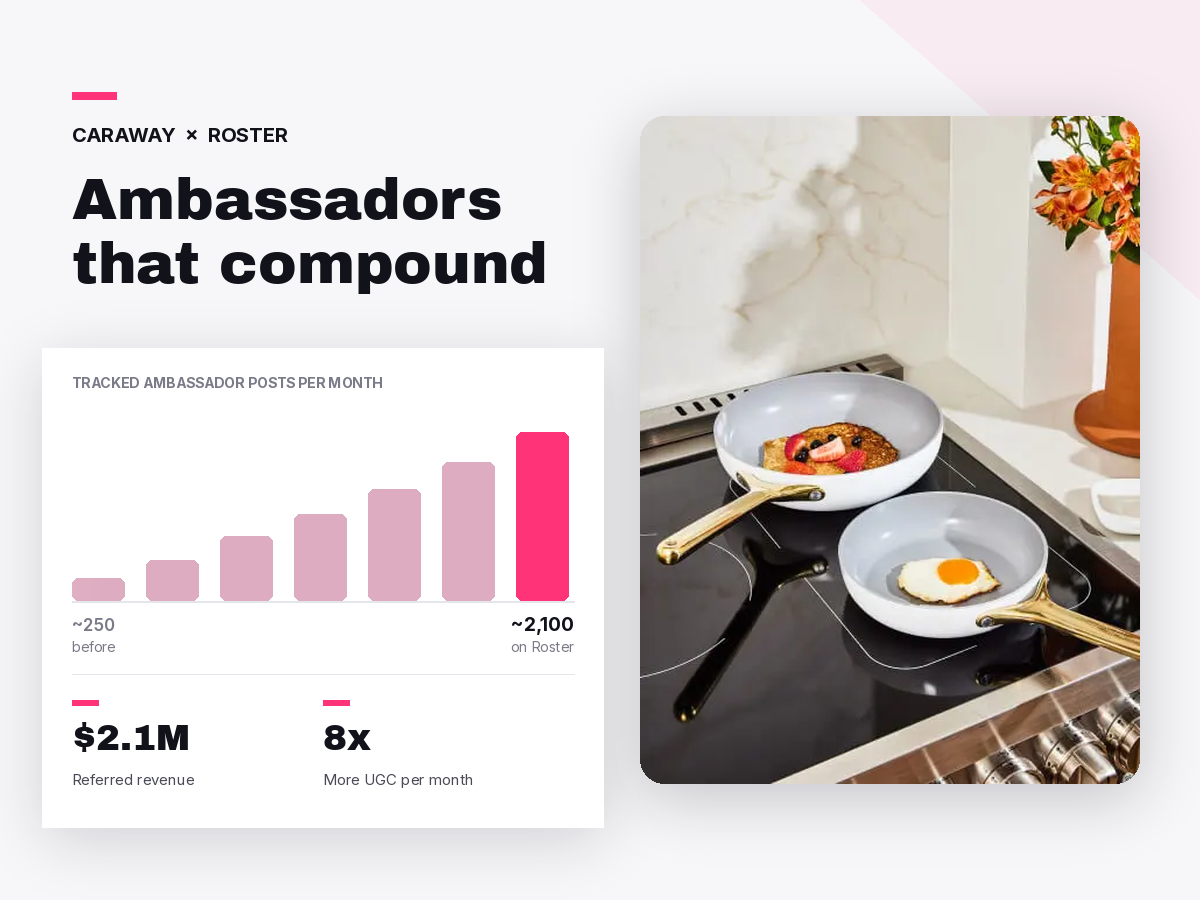
How Caraway built a brand ambassador program that drives 8x more UGC and over 2,000 posts a month
After outgrowing its previous ambassador platform, the modern cookware brand rebuilt its program around gamification with Roster, running natively on Shopify Plus. Two-plus years in, roughly 4,000+ ambassadors drive both referral revenue and about 2,100 tracked posts a month.
Results since June 2024
About Caraway
A brand built on clean materials, and a community that already talks about it
Caraway is a direct-to-consumer home goods brand best known for its ceramic-coated cookware, alongside bakeware, food storage, and kitchen tools, all built around a simple promise: Your Home, Made Better. The brand has centered its identity on swapping out PFAS and plastic for clean materials, and an ambassador program has been part of Caraway's marketing since its earliest days.
Caraway sells direct to consumers on Shopify Plus, alongside a growing wholesale footprint in Target, Crate and Barrel, Macy's, Walmart, and more. That matters for how the ambassador program is measured: every referred order lands in the same Shopify store the rest of the business runs on, so ambassador revenue is counted the same way DTC revenue is counted.
The ambassador team is run day-to-day by Taylor Garaventa and Savannah Godber, who manage everything from gifting and VIP tiering to content strategy and ambassador communications.
The model
An owned audience compounds. A rented one resets to zero.
Caraway's ambassadors sit at the center of many different functions. The program feeds paid and organic social through whitelisting and reposts, supports in-person brand events and product launches, and drives a steady stream of referral revenue and user-generated content.
That distinction is the part most brands get wrong. Caraway is not renting reach from a creator marketplace and paying per post. It activates people who already cook on Caraway pans and already talk about the brand, then gives them a reason to keep going.
Historically, revenue was the program's primary success metric. That has not changed, but a second mandate has grown alongside it: driving as much organic buzz as possible around product launches. The ambassador program has become the primary engine for making that happen.
The challenge
One campaign a month, no gamification, and a 24-hour wait for support
On its previous platform, new ambassadors were welcomed with a free pan, and each month the team ran a single, loosely structured campaign that ambassadors could opt into. It worked, but only in a limited way. Participation was inconsistent, because most ambassadors heard from Caraway once a month through a newsletter. Tiers, milestones, and rewards were missing entirely. Getting help meant filing a ticket and waiting roughly 24 hours, with no way to get a person on a call.
Here is what changed after the move to Roster in June 2024.
Roster gave us a way to gamify the ambassador experience: real tiers, real milestones, real rewards for showing up. That was the exact reason we made the move, to build a program on a platform that grows with the people in it. Taylor Garaventa Ambassador program, Caraway
How it runs today
Order-level attribution, because it reads Shopify directly
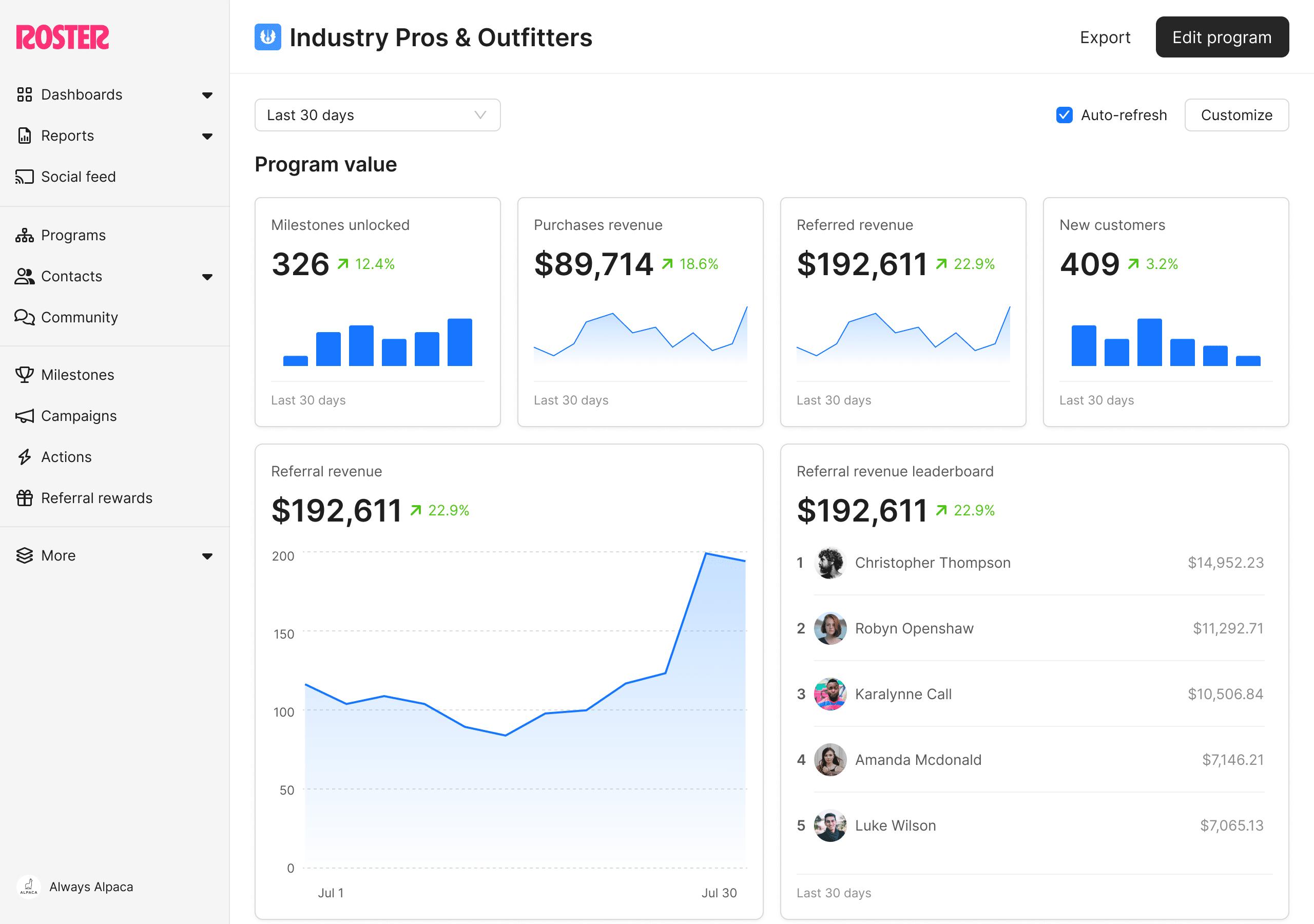
Roster installs from the Shopify App Store and reads orders directly from the Shopify store, which is why the numbers on this page are order-level attribution rather than modeled estimates. Each ambassador gets a unique referral link and discount code provisioned inside Shopify, so a referred sale is a real Shopify order with a name attached to it, not a last-click guess from a pixel that iOS may or may not have fired.
That has a practical consequence at Caraway's scale. When the team seeds a product through a campaign, ambassadors place their own orders through the Shopify storefront, which keeps inventory, discounts, and reporting in one system instead of a spreadsheet running alongside it.
The mechanics
Four things Caraway runs every month
Actions, not just campaigns
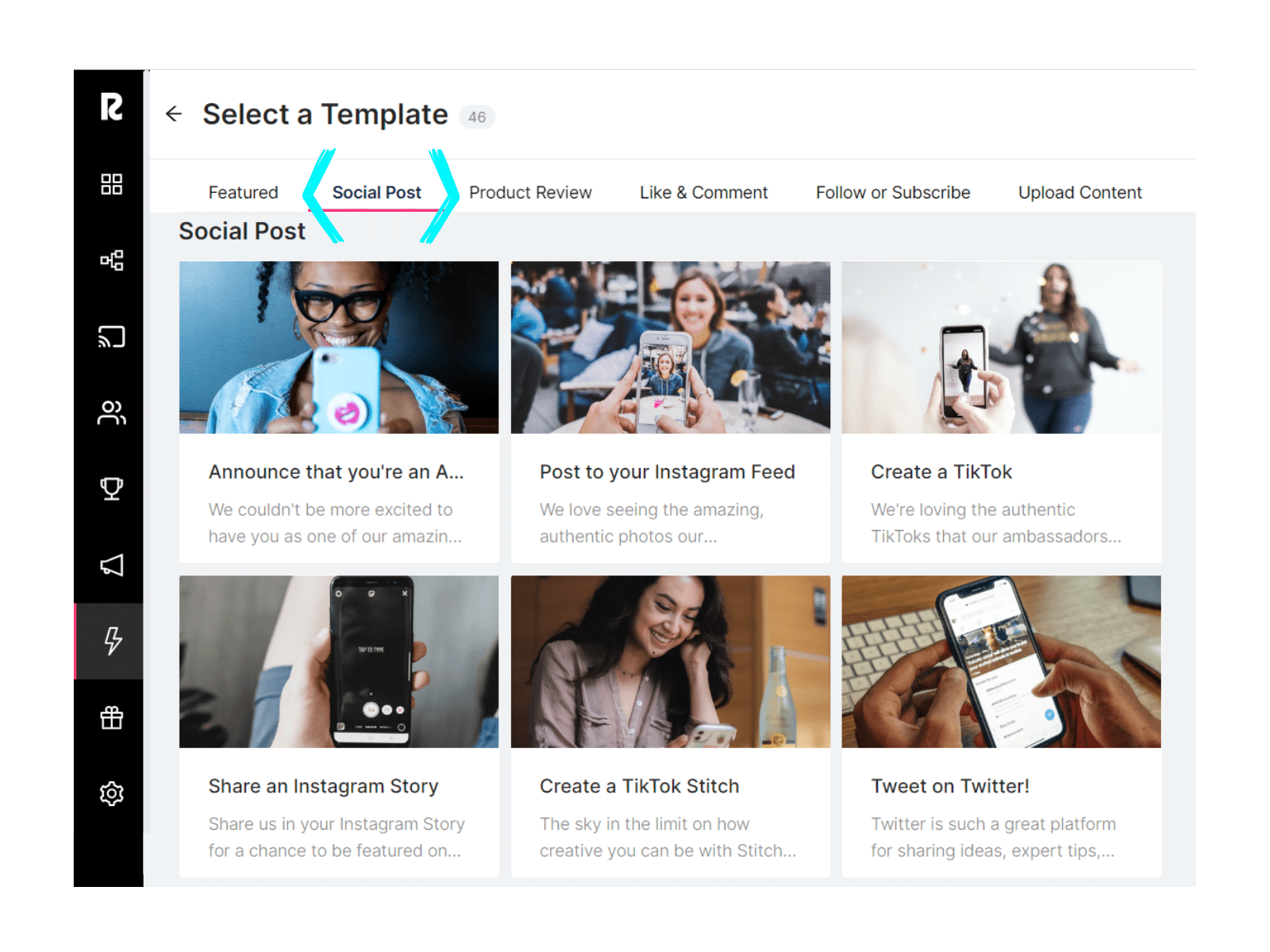
Quick, individual touchpoints sent straight to ambassadors' inboxes with clear links and instructions. Ambassadors respond far more reliably to these than to open-ended campaign sign-ups. Caraway now sends roughly 60 Actions a month, up from about 20 during the 2024 holiday ramp.
Campaigns for UGC and seeding
Campaigns are still the tool of choice for UGC-specific requests and product seeding, since a campaign lets ambassadors place their own orders rather than requiring the team to seed each person manually.
A VIP tier built on revenue
Around 40 to 50 top ambassadors carry a VIP tag. The primary bar is about $40,000 in revenue over multiple quarters or a year. Smaller launches also extend priority to high-volume posters who have not hit that bar yet.
Tapping into nano-creators
The follower minimum was recently lowered from 10,000 to 5,000, a previously untapped tier that has performed well. A creator who actually cooks with Caraway converts better than one with ten times the audience who does not.
The results
A single VIP cohort referred $2.1M, and Caraway kept all of it
In 2025, a selective cohort of VIP-tagged Caraway ambassadors generated more than $2.1M in referred revenue, tracked as real Shopify orders, off roughly 73,000 link clicks. That is an approximately 8% click-to-order conversion rate, and it referred more than 4,300 new customers. The single top-performing ambassador in that group drove over $465,000 in referred revenue and nearly 950 new customers in 2025 alone.
An 8% click-to-order rate is what an owned audience looks like. Paid social at a comparable cookware AOV does not convert anywhere near that, because the person clicking already trusts the person who posted. And Caraway keeps all of it: Roster charges a flat subscription with zero commissions, so no platform take rate skims the top of a $2.1M cohort.
Figures are order-level Shopify attribution for the VIP cohort in calendar year 2025.
We weren't sure what to expect after inconsistent performance with previous vendors. Roster's performance isn't a one-time spike. It's been consistent program growth since the day we joined, and the results keep compounding. Taylor Garaventa Ambassador program, Caraway
In their words
What the Caraway team says
On our old platform, getting help meant filing a ticket and waiting a full day for a reply. With Roster, there's actually someone to get on the phone, and that's how a program is supposed to feel personal. Taylor Garaventa Caraway
We used to get two or three hundred pieces of UGC a month. With Roster, it's thousands, every single month, and it keeps climbing. Taylor Garaventa Caraway
Roster's Actions delivered results in a way campaigns never did. We email an ambassador directly, link exactly where we want them to go, and they actually read it. Taylor Garaventa Caraway
Ambassadors are the most underrated channel in influencer marketing. Most ecommerce brands have no idea how much of a growth engine their ambassadors could be for both UGC and revenue. Savannah Godber Caraway
Key takeaways
What made the difference
- Gamification was the missing piece. Tiers, milestones, and responsive support turned a program that leaned on one campaign a month into an always-on engine.
- Small, frequent touchpoints beat big, infrequent ones. Actions now outnumber the old campaign cadence roughly 3 to 1 per month, and ambassadors engage with them more reliably.
- Ambassadors are a full content engine, not just a referral channel. Monthly content volume has grown roughly 8x, and it has held steady rather than spiking and fading.
- Zero commission changes the math at scale. A flat subscription means a $2.1M cohort stays worth $2.1M to the brand.
- There is still more to unlock. Caraway is actively exploring campaign-based product seeding, deeper reuse of ambassador content on organic social, and AI-assisted reporting through Roster's MCP integration.
FAQ
Frequently asked questions
Keep reading