Social commerce isn't a new channel. It's a shorter path — discovery and checkout collapsed into a single moment, on a surface where nobody arrived intending to buy anything.
That compression changes what wins. On your own site, a shopper arrives with intent and your job is to remove friction. In a feed, there is no intent to work with. Something has to create it in the first few seconds, and a brand account is structurally bad at that while a person recommending something they own is structurally good at it.
Which is why the brands doing well here are not the ones with the best ad creative. They're the ones with a supply of people willing to talk about the product.
Social commerce is buying that completes inside the social platform rather than on a brand's own site. The mechanics differ by platform and change often, but the constraint doesn't: purchases are made in a discovery context, by people who weren't shopping, on the strength of whoever is on screen.
Platform features, fees and availability change frequently. Check the current documentation for any specific platform before building a plan around its mechanics.
Why creator supply is the real constraint
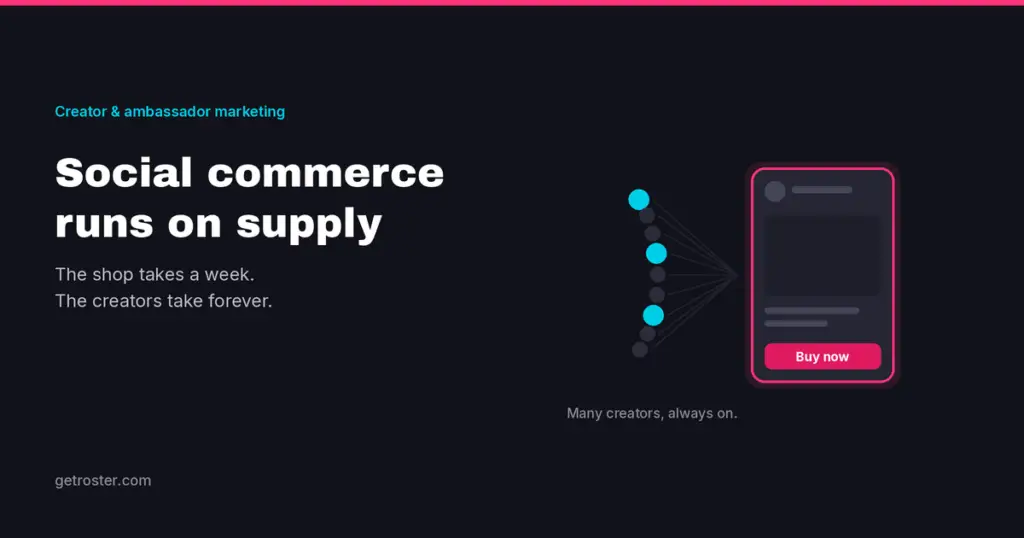
Most brands approach social commerce as a setup problem: open the shop, sync the catalogue, list the products. That part is administrative and takes a week.
Then the storefront sits there, because a product listing in a feed is not content and nothing surfaces it. The platforms distribute content, not catalogues, and the only reliable source of content at the volume these surfaces consume is a group of people making it continuously.
Three things follow:
Volume beats polish. These feeds reward frequency and variance. One agency-produced video a month cannot compete with thirty real ones, and the economics of commissioning at that volume don't work — which is what makes seeding and an ambassador roster the practical supply rather than a nice-to-have.
The person carries the sale. There's no product page to do the persuading, no reviews section, no comparison. The recommendation and the transaction happen in the same thirty seconds, and the only credibility available is whoever is speaking.
Attribution is native. Unlike most social activity, a creator-driven sale in social commerce is directly traceable to a person. That makes commission-based relationships straightforward — and it makes measuring the programme far easier here than on channels where you're inferring influence from correlation.
What to change in your program
| Area | Traditional creator program | Built for social commerce |
|---|---|---|
| Recruiting | A small number of creators with large audiences | A large number of customers who post — audience size matters much less than volume and fit |
| Cadence | Campaign-based, a few times a year | Always on. The feed has no campaign calendar |
| Product supply | Sent for specific campaigns | Continuous, so people always have something to show |
| Pay | Flat fees per deliverable | Commission, because the sale is traceable to the person who caused it |
| Success measure | Reach and engagement | Revenue per creator, and how many creators posted at all this month |
The pay row is the significant one. Social commerce makes performance-based relationships genuinely practical, because the platform tells you which creator drove which sale. How you structure commission becomes the main lever you have, and flat fees start looking like an expensive way to buy something you could have bought on results.
The shop is the easy part. The supply isn't. Roster recruits ambassadors from your existing customers, keeps product moving to them, and tracks what each person sells — see how ambassador programs run.
Getting the supply side right
Recruit for willingness, not reach
The useful question is who will post twice a month, not who has the biggest following. A customer with 3,000 followers posting regularly is worth more here than a creator with 100,000 who posts once — and finding those people starts with your own customer list.
Keep product in their hands
Continuous seeding rather than campaign drops. Someone who received a package eight months ago has nothing current to talk about, and a feed that rewards frequency punishes gaps.
Make commission the default
Where the platform attributes sales natively, commission aligns everyone without negotiation and scales without a budget conversation. Keep flat fees for specific assets you need, not as the structure.
Don't leave the content on one platform
The videos that sell in social commerce are frequently your best paid creative too. Collect them with usage rights attached and run the winners as ads — turning top-performing UGC into paid ads covers the selection and licensing, and collecting UGC legally covers the rights you need first.
Expect platform risk
Any single social platform can change its rules, its economics or its availability with little warning. A roster of people who advocate for you is portable; a strategy built entirely inside one platform's commerce features is not. Build the relationships in a system you control, and treat each platform as a distribution surface rather than the foundation.
Disclosure still applies
Creators earning commission on sales have a material connection and must disclose it, and the obligation extends to the brand. The compressed format makes this easier to get wrong — a fifteen-second video has no room for a buried hashtag block, so the disclosure needs to be in the content itself.
Put the requirement in your program terms and the campaign brief. The FTC's endorsement guides Q&A covers the common situations.
General guidance, not legal advice. Platform policies and regional rules apply on top.
Where brands get it wrong
- Treating it as a listing exercise. The catalogue sync is a week of work. The creator supply is the actual project, and it's ongoing.
- Recruiting a handful of large creators. These surfaces consume content faster than a small group can produce it. Breadth beats prestige.
- Campaign thinking. Quarterly pushes produce quarterly results on a channel that rewards constant presence.
- Paying flat fees when sales are traceable. You're paying for effort on a channel that will tell you about outcomes.
- Letting the content live and die in one app. The best-performing videos are ad creative you already own the relationship for.
- Building on one platform's features. Own the roster. Rent the surface.
If you're starting from nothing, the sequence is the same as any advocacy program — the program template covers the build, and structuring ambassadors and affiliates together covers how the roster scales once it's working.
Own the roster, not just the storefront. Roster keeps your ambassadors supplied, tracks what each one sells, and collects the content so it can work on more than one platform.
Frequently asked questions
Why do ambassadors matter for social commerce?
Social commerce purchases happen in a discovery context, where nobody arrived intending to buy. There's no product page doing the persuading — the person on screen is the entire basis for the sale, which makes a supply of credible people the binding constraint.
How many creators do I need for social commerce?
More than you'd think, and smaller than you'd think. These feeds consume content at a rate a handful of large creators can't match, so breadth of participation matters more than individual audience size.
Should I pay commission or flat fees in social commerce?
Commission, in most cases. Where the platform attributes sales to the creator natively, performance-based pay aligns incentives without negotiation and scales without a budget conversation. Reserve flat fees for specific assets you need on a date.
Can I reuse social commerce content as ads?
Yes, and you should — the videos that sell in-feed are frequently your best paid creative. Collect usage rights up front rather than after something performs, and run the winners from the creator's own handle where the platform allows it.
What's the biggest mistake brands make with social commerce?
Treating it as a setup task. Syncing the catalogue takes a week; building and maintaining the creator supply that makes the storefront visible is the ongoing work, and it's where programs succeed or stall.
How do I reduce platform risk?
Keep the ambassador relationships in a system you control rather than inside one platform's creator tools, and collect content with rights that let you use it elsewhere. Treat each platform as a distribution surface, not the foundation of the program.