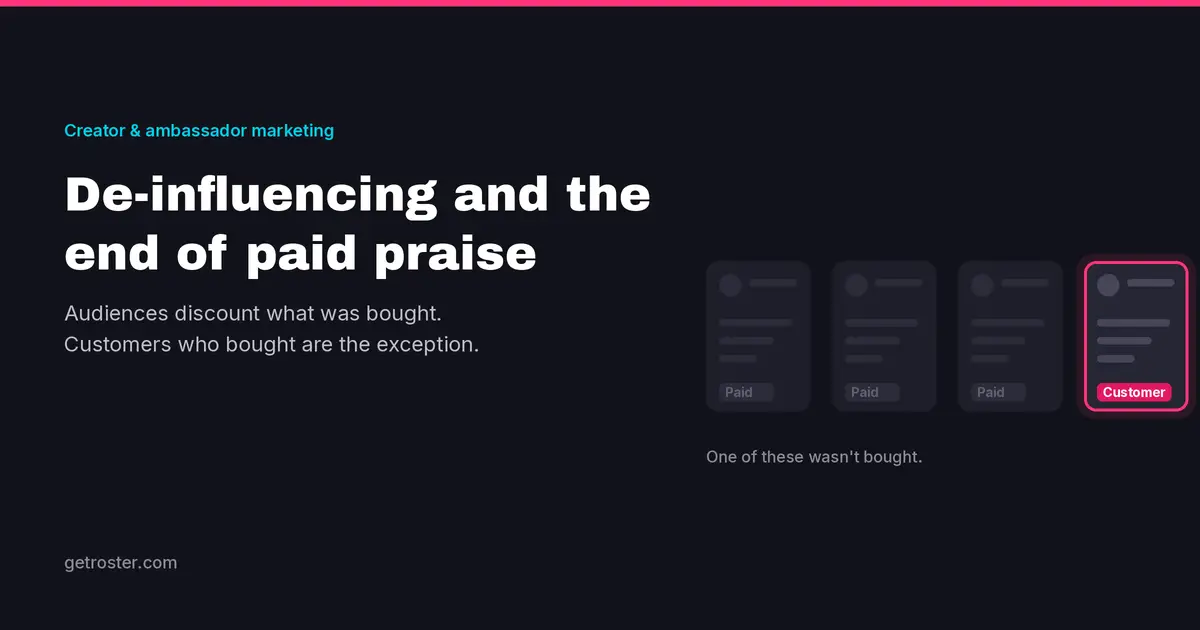
De-influencing is creators telling their audience what not to buy — naming overhyped products, recommending cheaper alternatives, or explaining why something didn't work. It reads as a backlash against sponsored content, but it is better understood as a correction: audiences rewarding people who are willing to say no, because saying no is evidence that the yes means something.
For brands, the instinct is to treat this as a threat to manage. It isn't. De-influencing is a filter, and what it filters out is paid recommendation that was never credible in the first place. If your creator program depends on people saying only positive things in exchange for money, it was always going to age badly. If it depends on customers who already bought the product, very little changes.
What actually changed
Sponsored content didn't stop working because audiences became cynical overnight. It stopped working because the supply got too large to ignore.
When one post in fifty was paid, disclosure was a curiosity. When most product recommendations in a feed are paid, audiences develop a default assumption — this person was paid to say this — and that assumption now attaches to every recommendation, including the honest ones. De-influencing is the market's response: a creator who criticises products establishes that they aren't operating under that default.
The practical consequence for brands is that the signal has moved. Reach and engagement still tell you how many people saw something. They no longer tell you whether anyone believed it.
What this means if you're past $1M in revenue
Three things follow, and none of them require abandoning creator marketing.
Your customers are the durable supply
A customer who bought the product with their own money and posts about it is structurally immune to the de-influencing critique. There's nothing to disclose because nothing was exchanged, and the audience can verify the relationship in their posting history. This is why recruiting ambassadors from your existing customer base outperforms hiring creators who have never bought from you — not because it's cheaper, though it usually is, but because the credibility is real rather than purchased.
Negative mentions are information, not incidents
When a creator in your program says a product runs small, or isn't worth it for a particular use case, the reflex is damage control. Resist it. A program where nobody ever says anything qualified is a program the audience has already discounted. Qualified praise — "this is excellent for X, don't buy it for Y" — converts better than unqualified praise, because it demonstrates the person is making an assessment rather than reading a brief.
Over-briefing is now a conversion problem
Mandated talking points, required phrases, and approval rounds produce content that sounds like an ad, and audiences are unusually good at detecting it. The brief should cover what's factually accurate and legally required. Everything else — the angle, the framing, the words — belongs to the person whose audience it is.
Building a program that survives it
| Practice | What to do instead |
|---|
| Recruiting by follower count |
Recruit from customers and from people already posting about you. Audience size is a reach input, not a trust input. |
| Scripted talking points |
Brief on accuracy and disclosure only. Let the creator decide the angle. |
| Approval rights over content |
Approval over factual claims, not over tone. Content the brand rewrote reads as brand content. |
| One-off paid campaigns |
Long-term relationships where the creator's own use of the product accumulates visibly over time. |
| Judging on reach and engagement |
Judge on tracked revenue per creator, plus repeat posting without prompting. |
The last row is the one that changes behaviour. Reach rewards whoever has the largest audience. Attribution that resolves to a person rewards whoever actually persuades people — and those are frequently much smaller creators whose recommendations still carry weight precisely because they haven't been monetised into noise.
Disclosure is a trust asset, not a tax
Most brands treat the disclosure requirement as a compliance minimum — the smallest legible marker that satisfies the rule. That's backwards in a de-influencing environment.
Audiences already assume a commercial relationship exists. Clear disclosure doesn't reveal something damaging; it removes the suspicion that you were hiding it. The creators who disclose prominently and still get believed are the ones who have established that disclosure doesn't change what they say.
Practically: put the disclosure where it's visible without tapping "more", use plain words rather than an ambiguous tag, and apply it to gifted product as well as paid placements. The FTC's endorsement guides Q&A and its guidance for brands on endorsements and reviews both set out where responsibility sits — and it sits with the brand as well as the creator.
General guidance, not legal advice. Requirements differ outside the US.
What to measure instead of authenticity
"Authenticity" isn't a metric, and treating it as one produces vague reporting. Four proxies are measurable and behave the way authenticity is supposed to:
- Unprompted repeat posts. How many creators posted again without being asked or paid. The single strongest signal that the relationship is real.
- Revenue per creator, through tracked codes and links, rather than reach per creator.
- Conversion rate on creator traffic versus your site average. Persuaded traffic converts differently from curious traffic.
- Customer-to-ambassador rate. What share of your program are people who bought before they joined. This is the number that determines whether the whole thing holds up under scrutiny.
The wider framework for this sits in measuring program ROI, and product seeding is the cheapest way to find out who will post about you without being paid — which is exactly the group de-influencing doesn't touch.
The uncomfortable part
De-influencing is only a threat if the criticism would be accurate. A program built on customers who genuinely like the product has very little exposure; a program built on paying strangers to praise a product they don't use has a great deal.
That makes this less a marketing question than a product one. The brands least affected by the trend are the ones whose customers were already saying the thing the creators were being paid to say.
Build the program on people who already bought. Roster recruits ambassadors from your customer list, tracks what each one drives, and keeps the content coming — without a brief that makes it sound like an ad.
Book a demo →
Frequently asked questions
What is de-influencing?
De-influencing is creators telling their audience what not to buy — naming overhyped products, suggesting cheaper alternatives, or explaining why something didn't work for them. It emerged as a reaction to the volume of sponsored content in social feeds.
Is de-influencing bad for brands?
It's bad for programs built on paid praise from people who don't use the product. It's close to neutral for programs built on customers who bought with their own money, because there's no purchased endorsement to undermine.
How should brands respond to de-influencing?
Recruit from your own customers, brief on accuracy rather than on talking points, allow qualified and negative mentions, and measure tracked revenue per creator instead of reach. Each of those makes the endorsement harder to dismiss.
Should we let ambassadors say negative things about our products?
Yes, within reason. Qualified praise — what a product is good for and what it isn't — converts better than unqualified praise, because it shows the person is assessing rather than reciting. A program where nobody ever qualifies anything has already lost the audience's trust.
Does disclosure hurt performance?
Audiences generally assume a commercial relationship exists anyway. Clear disclosure removes the suspicion of concealment rather than creating it, and it's a legal requirement for both gifted and paid arrangements in the US.
How do you measure authenticity in creator marketing?
You don't measure it directly. Use proxies: unprompted repeat posts, revenue per creator through tracked links, conversion rate on creator traffic against your site average, and the share of your program who were customers before they were ambassadors.