Most programs don't fail at launch. They fail at about forty people — the point where manual recruiting, manual payouts and a spreadsheet of discount codes stop being survivable, and the program quietly becomes whatever the person running it has time for that week.
Scaling past that isn't about recruiting harder. It's about structure: one program that holds both ambassadors and affiliates, with clear rules for where someone enters, how they move, and what happens automatically.
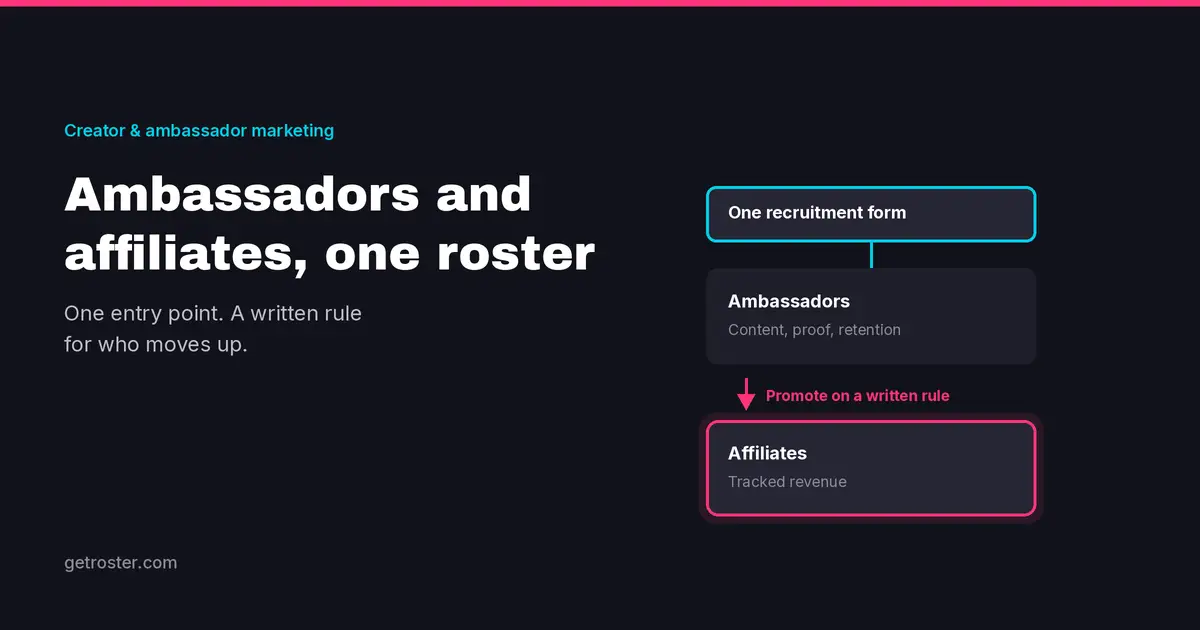
An ambassador affiliate program runs both models under one roof. Ambassadors are customers who advocate — they produce content and credibility. Affiliates are partners who sell — they produce tracked revenue. Most brands need both, and running them as two disconnected programs is what makes each one harder to grow.
Why the two models belong together
Treated separately, each has a hole the other fills.
An ambassador program produces content, social proof and retention, but revenue attribution is soft and the people in it often aren't motivated primarily by money. An affiliate program produces clean, trackable revenue, but affiliates have no particular loyalty — they promote whoever converts best this quarter, and they rarely make content worth reusing.
Run together, they form a progression. Customers enter as ambassadors because they already like the product. The ones who turn out to be good at selling move onto affiliate terms. You end up recruiting affiliates from a pool of people who have already demonstrated both that they use the product and that their audience responds — which is a far better filter than any outreach list.
If you're still deciding whether you need one model or both, ambassadors versus affiliates covers that choice directly.
Where each type belongs
| Ambassadors | Affiliates |
|---|
| Who they are | Existing customers with an audience, however small | Partners, publishers, and creators who sell for a living |
| Primary output | Content, social proof, retention | Tracked revenue |
| Recruited from | Your customer list and people already posting about you | Your own ambassador roster, first — outreach second |
| Paid with | Product, credit, access, small commission | Commission, sometimes with a performance bonus |
| Judged on | Active rate and cost per usable asset | Attributed revenue and program CAC |
The recruiting row is the one that changes how the program feels. Most brands treat affiliate recruitment as cold outreach. Promoting from your own ambassador roster costs nothing, converts better, and produces partners who actually use the product.
Four structural decisions
1. One entry point, not two
Applicants shouldn't have to know the difference between your programs to join the right one. A single recruitment form that routes people to the appropriate track based on what they tell you removes a decision the applicant isn't equipped to make — and stops you losing good customers who picked the wrong door.
2. Movement between tracks has to be a rule, not a favour
Define the threshold in advance: X in tracked sales over Y months moves someone onto affiliate terms automatically. Without a written rule, promotion becomes a conversation, conversations don't scale, and the people who get promoted are the ones who asked rather than the ones who earned it. Tier design is the mechanism; the rule is the part that matters here.
3. Attribution before recruitment
Every person in either track needs a unique link and discount code from day one. Retrofitting attribution onto a live roster of 200 people is genuinely painful, and until revenue resolves to a person you can't operate the promotion rule in point two, because you can't see who qualifies. Measuring program ROI covers the full method.
4. Separate programs, shared roster
If you run several brands, regions or product lines, keep them as distinct programs with their own terms and reporting, drawing from one person database. Splitting people across disconnected systems is the thing that makes scale expensive — you lose the history that tells you who to promote.
Starting with no budget
A performance-only program is a legitimate way to begin, and for brands that can't justify a content budget yet it's usually the right one.
- Recruit from customers only. People who already bought will join for product and a code. Nobody else will join for nothing, so don't waste the outreach effort.
- Pay in product at entry. Costs you COGS, not retail. Product seeding is the cheapest way to find out who will actually post.
- Commission only above the entry tier. The program pays for itself by construction, and you never have a budget conversation about a channel that only costs money when it works.
- Add a base later, once you know the numbers. A small base fixes the cold-start problem, but only once you know what a good ambassador produces. How to structure the pay covers when that's worth it.
The trade is speed. Performance-only programs grow more slowly because there's no incentive to join before the product sells itself. Accept that rather than fixing it with flat fees you'll struggle to unwind.
Compliance scales too
Once a roster passes a few dozen people, disclosure stops being something you can eyeball. Affiliates posting tracked links and ambassadors receiving product are both material connections requiring clear disclosure, and the responsibility sits with the brand as well as the individual.
Put the requirement in the program terms everyone accepts at signup, repeat it in campaign briefs, and spot-check monthly. The FTC's endorsement guides Q&A covers the common cases.
General guidance, not legal advice.
What breaks at scale
- Manual payouts. The single most common reason programs stall. At 40 people it's an afternoon a month; at 200 it's a job nobody has.
- Undefined promotion. Without a written threshold, moving between tracks becomes political and your best sellers leave for a program with clearer terms.
- Recruiting affiliates cold while ignoring your own roster. The best affiliate candidates are usually already in your ambassador program, with a track record attached.
- Two disconnected systems. Ambassadors in one tool, affiliates in another, no shared history. You lose exactly the data that tells you who to promote.
- Scaling recruitment before attribution. A large roster you can't measure is more expensive than a small one you can. Get the tracking in first.
If you're building from zero rather than restructuring, start with the program template and price it with what a program actually costs. If the problem is that your existing roster has gone quiet rather than that it's too small, that's an engagement problem, and adding people won't fix it.
Structure it once, then grow into it. Roster handles both tracks, automatic tier movement, tracked attribution and payouts — so the program that works at 40 people still works at 400.
Book a demo →
Frequently asked questions
What is an ambassador affiliate program?
It's a single program running both models: ambassadors who are customers producing content and credibility, and affiliates who are partners producing tracked revenue. People typically enter as ambassadors and move onto affiliate terms once they demonstrate they can sell.
Should ambassadors and affiliates be separate programs?
Separate terms, shared roster. Each needs its own compensation and measurement, but splitting them across disconnected systems loses the history that tells you which ambassadors are ready to be promoted.
How do you scale an ambassador program past 50 people?
Automate payouts, write down the promotion threshold instead of deciding case by case, and make sure every person has tracked attribution from day one. Manual payouts and undefined promotion are what stall programs, not a shortage of applicants.
Where should I recruit affiliates from?
Your own ambassador roster first. Those people already use the product and you have data on whether their audience converts — a far better filter than cold outreach, and it costs nothing.
Can I run an ambassador program with no budget?
Yes. Recruit only from existing customers, pay in product at the entry tier, and add commission above it so the program only costs money when it generates revenue. It grows more slowly than a funded program, which is the trade.
When should someone move from ambassador to affiliate?
Define it as a threshold in advance — a set amount of tracked sales over a set period — and apply it automatically. If promotion depends on a conversation, it won't scale and it'll favour whoever asks loudest.
What's the first thing to fix in a program that's stopped growing?
Check whether the problem is size or activity. If enrolled ambassadors have gone quiet, recruiting more won't help — that's an engagement problem. If they're active but few, the constraint is usually manual admin rather than interest.