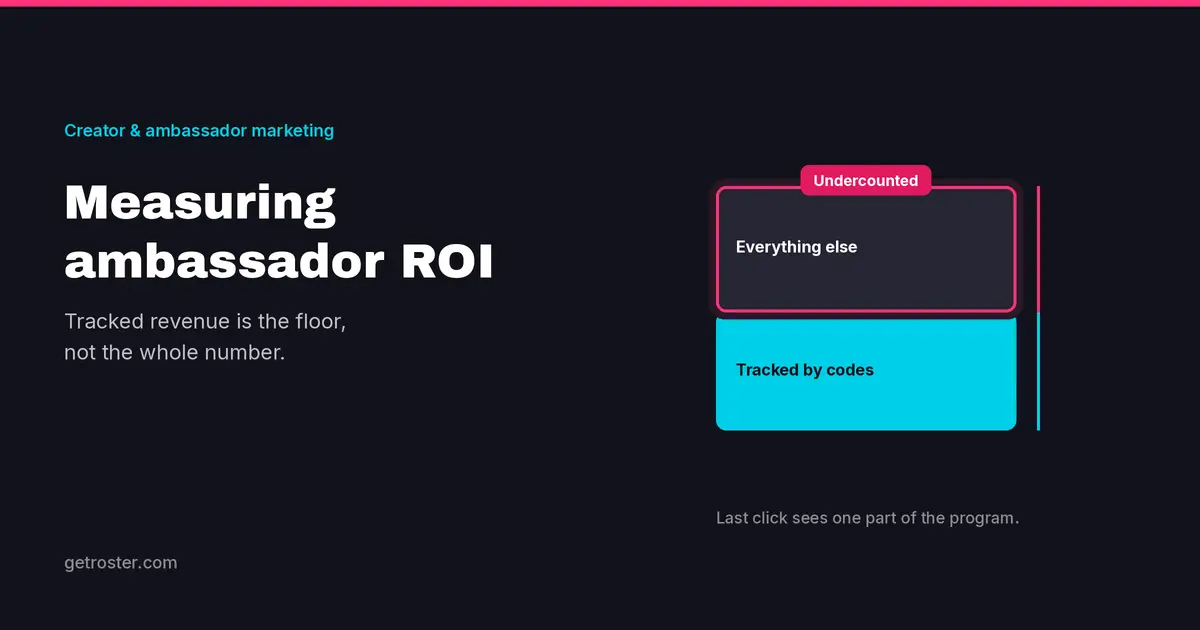
The short answer: you measure it at the person level, not the campaign level, and you accept that tracked revenue is a floor rather than the whole number.
Advocacy programs are systematically undercounted by the analytics most ecommerce brands already run. Someone sees an ambassador's post on Monday, thinks about it, searches your brand name on Thursday, and buys. Last-click credits that sale to organic search. The ambassador who caused it shows up in your reporting as having driven nothing — and the program looks weak next to paid social, which is measured in a way that flatters it.
Here is how to build measurement that survives a conversation with your CFO.
Program ROI, in this context, is the contribution margin generated by advocacy activity divided by the total cost of running it — commissions, product, platform and management time — measured over a defined window. The hard part is not the arithmetic. It is deciding what counts as "generated by."
Why last-click undercounts advocacy
Three structural reasons, all of which apply to every brand regardless of platform.
The gap between exposure and purchase is long. Ambassador content is discovery, not capture. It creates intent that converts days later through a channel that takes the credit. Paid search and retargeting are downstream of that intent and get measured as though they created it.
Not everyone uses the code. Discount codes capture the people who wanted the discount. Plenty of buyers see the post, remember the brand, and check out at full price. Those sales are real and invisible.
Content keeps working after the post. A seeded video that becomes your best-performing ad is a return on the ambassador program, but it lands in the paid social line of your reporting. Without a way to trace assets back to their source, creator content that becomes paid media is credited to the channel that ran it.
The five numbers that matter
| Metric | What it answers | How to get it |
|---|
| Attributed revenue per ambassador |
Who is actually driving sales, not who has the biggest audience |
Unique link and discount code per person, consistently applied |
| Program CAC |
Whether advocacy is cheaper than your alternatives |
Total program cost ÷ new customers acquired through it. Compare against blended paid CAC |
| LTV of referred customers |
Whether these buyers are better than average, not just cheaper |
Cohort your customer base by acquisition source and track repeat rate over 6–12 months |
| Cost per usable asset |
What the content alone is worth, before any sales |
Program cost ÷ assets you'd be willing to run as ads |
| Active ambassador rate |
Whether the program is compounding or decaying |
Share of enrolled ambassadors who posted or sold this month |
The second and third are the ones that win budget arguments. A program with a higher CAC than paid social can still be the better investment if referred customers repeat more often — and they frequently do, because they arrived through someone they trust rather than an interruption.
Participation and engagement have their own diagnostics — those sit in ambassador engagement rather than here.
Four attribution methods, in order of effort
1. Codes and links per person
The non-negotiable baseline. One tracked link and one unique code per ambassador, with their name attached to both, so attribution resolves to a person rather than to a campaign. Without this, nothing else on this list is possible and you're reduced to paying flat fees because they're the only thing you can administer.
What it gives you: a reliable floor on program revenue. What it misses: everyone who didn't use the code.
2. A post-purchase survey
One question at checkout — "how did you hear about us?" — with a free-text or creator-name option. Cheap to implement, and it consistently surfaces attribution that click tracking cannot see, because it asks the buyer instead of inferring from their last click.
Treat it as directional rather than exact. People misremember. But when 12% of buyers name a creator and your click data shows 4%, you've learned the size of the gap.
3. Holdout tests
The only method that proves incrementality rather than correlation. Pause ambassador activity in one region or for one segment for a defined period, keep everything else constant, and compare revenue against the active group.
It costs you real revenue during the test window, which is why most brands never run one. Run it once, properly, and you have a multiplier you can apply to tracked revenue for the next year — which is worth far more than another dashboard.
4. Cohort analysis by acquisition source
Tag customers with how they arrived, then track repeat purchase rate, average order value and churn by cohort over 6 to 12 months. This is where advocacy usually wins decisively, and it's invisible in any first-order view.
Measure each program type for what it's for
| Program | Primary metric | Common mistake |
|---|
| Affiliates |
Attributed revenue and program CAC |
Counting sales from people who would have bought anyway — discount-code hunters inflate the number |
| Ambassadors |
LTV of referred customers, plus cost per usable asset |
Judging on first-order revenue only, which misses both the retention effect and the content value |
| Paid influencers |
Cost per usable asset, then paid performance of that asset |
Reporting reach and engagement, neither of which is an outcome |
The distinction matters because the models pay for different things — which is the argument in ambassadors versus affiliates and how you structure the pay. Measuring an ambassador program on affiliate metrics will make a good program look mediocre.
Where measurement goes wrong
- Reporting reach. Impressions are an input. If reach appears in your program report and revenue doesn't, the report is telling you nothing about ROI.
- Attributing to campaigns instead of people. Campaign-level data tells you last month went well. Person-level data tells you who to recruit more of, which is the decision that compounds.
- Comparing tracked program revenue to blended paid revenue. One is a floor and the other is inflated by last-click. Compare like with like, or apply the multiplier from your holdout test.
- Ignoring the content line entirely. If seeded content becomes ad creative, that value belongs to the program that produced it. Product seeding in particular looks expensive until you count what the assets would have cost to commission.
- Measuring too early. Ambassador programs compound. Judging month two is judging the cold start, not the channel.
A reporting cadence that holds up
- Monthly — attributed revenue, program CAC, active ambassador rate, new assets collected. Ranked by person, not by campaign.
- Quarterly — cohort comparison of referred versus non-referred customers on repeat rate and AOV. This is the slide that protects the budget.
- Annually — one holdout test to establish your incrementality multiplier, and a review of which ambassador profiles consistently produce revenue so recruiting targets the right people.
If you're setting a program up from scratch, build the tracking before the first ambassador joins — retrofitting attribution onto a live program is considerably harder than starting with it. The program template covers that sequence, and program cost covers the denominator.
Prove the channel, then scale it. Roster attributes revenue to the individual ambassador, tracks content and payouts in the same place, and gives you the CAC and LTV comparison your finance team will ask for.
Book a demo →
Frequently asked questions
How do you measure brand ambassador ROI?
Divide the contribution margin generated by the program by its total cost — commissions, product, platform and management time. Track revenue through a unique link and code per ambassador, then adjust upward for the sales tracking can't see, ideally using a holdout test or a post-purchase survey.
Why does last-click attribution undercount ambassador programs?
Ambassador content creates intent that converts days later, usually through branded search or direct traffic, so last-click credits the final channel rather than the one that caused the purchase. Buyers who don't use the discount code are invisible entirely.
What's a good ROI for an ambassador program?
There's no universal number, because it depends on your margin and what you'd otherwise pay to acquire the same customer. The useful comparison is program CAC against blended paid CAC, combined with the repeat rate of referred customers — a slightly higher CAC is a good trade if those customers come back more often.
How do you track creator-driven sales?
Give every creator a unique tracked link and discount code with their name attached, and keep both consistent across organic and paid usage. Add a post-purchase survey to capture the buyers who never touched the link.
How do you prove ambassador marketing is incremental?
Run a holdout test: pause ambassador activity for one region or segment for a defined period, hold everything else constant, and compare revenue against the active group. It costs real revenue during the window, which is why it's rare — and why the resulting multiplier is worth having.
Should I measure ambassadors and affiliates the same way?
No. Affiliates are a sales channel, so attributed revenue and program CAC are the right measures. Ambassadors produce content and retention as well as sales, so judging them on first-order revenue alone will understate a program that's working.
How long before an ambassador program shows ROI?
Expect the first quarter to be a cold start rather than a result. Programs compound as content accumulates and the roster matures, so cohort comparisons at six and twelve months tell you far more than a month-two report.