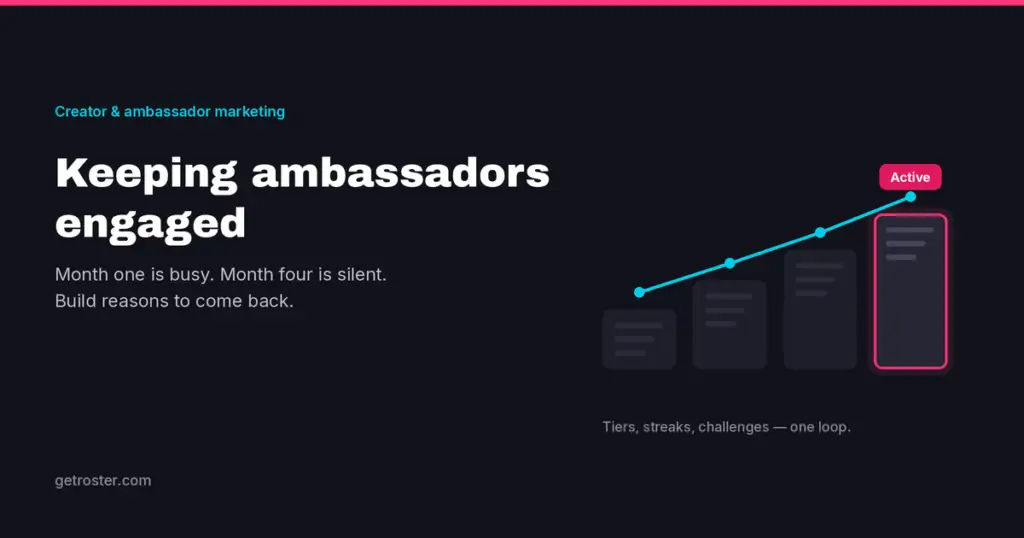
Almost every ambassador program has the same shape. Month one is busy. Month two is quieter. By month four a handful of people are carrying the whole thing and the rest have gone silent — still technically enrolled, no longer posting.
That decay is not a motivation problem. It's a design problem. Most programs give someone a reason to join and no reason to come back, and gamification — done properly — is just the practice of building in reasons to come back.
Done badly it produces leaderboards nobody looks at and badges nobody wants. Here is the version that works, what to measure, and what tends to backfire.
Ambassador engagement is the share of enrolled ambassadors who take a meaningful action — a post, a referral, a piece of content — inside a given month. It's the number that decides whether your program compounds or quietly becomes a list of names.
Why engagement drops after month two
Three things cause most of the decay, and each has a different fix.
The novelty was the motivation. Joining was the interesting part. Once the welcome kit is opened and the first post is up, nothing in the program asks for anything else. There's no next thing.
Effort and reward are disconnected. A commission that pays out occasionally and invisibly doesn't feel like a response to what someone did last Tuesday. If the feedback loop is longer than a few days, it stops functioning as a loop.
Nobody noticed. This is the one brands underrate most. Ambassadors are usually customers first, and people who post about a brand they like are partly doing it for acknowledgement. Silence from the brand reads as indifference.
Ten mechanics that keep ambassadors active
1. Monthly leaderboards, scoped small
A single global leaderboard demotivates everyone outside the top five. Segment it — by tier, by cohort, by join month — so most people can see themselves in reach of the top. Publish it on the same day every month so it becomes something people check rather than something they receive.
2. Levels people can see themselves climbing
Progress needs to be visible mid-way, not just at the moment of promotion. "Four more posts to Silver" does more work than the promotion itself. Structure belongs in the tier design — we cover that in the three-tier framework — but the engagement job is making the next rung legible from where someone is standing.
3. One monthly challenge, not five
A single clear prompt — one theme, one deadline, one reward — outperforms a menu of options. Choice creates hesitation. Rotate the theme monthly so returning ambassadors get something new without you rebuilding the program.
4. Streaks for consistency, not volume
Rewarding total output favours the people who were already your top performers. Rewarding consistency — posted in three consecutive months — is winnable by the middle of your roster, which is where the growth actually is.
5. Milestones tied to their history, not the calendar
First sale, tenth post, one-year anniversary. These land harder than a seasonal campaign because they're about that person. They also cost nothing but a message and a note in the CRM.
6. Recognition ahead of rewards
Resharing someone's content to your brand account, naming them in a newsletter, or featuring them on a product page is frequently more motivating than a discount. It's also free, and it gives them something to show their own audience.
7. Badges that gate something real
A badge that unlocks early product access or a higher commission rate means something. A badge that is only a badge is decoration, and ambassadors work it out within a month.
8. Access as the top-tier reward
Early product, a private group, input into a launch, a call with the founder. Access scales better than cash at the top of a program because it costs you little and can't be matched by a competitor offering a bigger percentage.
9. Progress people can check themselves
If someone has to email you to find out how they're doing, they won't. A dashboard showing their own posts, sales, and tier progress converts a passive enrolment into something they visit — ambassador profiles are what make that possible without manual reporting.
10. Let people choose their reward
Some ambassadors want product, some want commission, some want exposure. Offering a choice at each tier raises perceived value at no additional cost, and tells you something useful about who you're working with. How you structure the underlying pay is a separate decision from how you present it.
None of this survives a spreadsheet. Leaderboards, tiers, streaks and milestones all need activity tracked per ambassador, every month. Roster does that automatically — see what moving off spreadsheets looks like.
What to measure
Gamification is easy to feel good about and hard to judge. Four numbers make it real:
| Metric | What it tells you |
|---|---|
| Monthly active rate | Share of enrolled ambassadors who posted or referred this month. The headline number — track it as a trend, not a snapshot. |
| Month-three retention | Share of a join cohort still active in their third month. This is where programs die, so it's where gamification has to prove itself. |
| Participation depth | Share of actives who are outside your top ten. If the same people win every month, the mechanics are rewarding your existing stars rather than activating the middle. |
| Revenue per active ambassador | Keeps engagement honest. Activity that doesn't eventually show up in tracked codes and links is a hobby, not a channel. |
Set your own baseline over three months before judging any single mechanic, and change one thing at a time. Running a new challenge, a new tier and a new leaderboard in the same month tells you nothing about which one worked. The wider measurement picture is covered in measuring program ROI.
Where gamification backfires
- Competition where there should be community. A public leaderboard in a small, tight program can turn collaborators into rivals. If your ambassadors talk to each other, favour streaks and milestones over rankings.
- Rewarding volume over quality. Point-per-post scoring reliably produces low-effort posts. Weight toward content you'd actually reuse, or toward tracked sales.
- Mechanics nobody can see. A tier system that only exists in your spreadsheet motivates no one. If ambassadors can't check their own progress, it isn't a mechanic.
- Escalating prizes. Each campaign bigger than the last trains people to wait for the big one and ignore everything else.
- Gamifying instead of paying. Badges do not substitute for commission on a program that generates real revenue. Gamification raises participation among people who are already fairly compensated; it can't paper over rates that aren't.
Rewards create a disclosure obligation
Worth saying plainly, because gamification makes it easy to miss: once someone receives anything of value in exchange for posting — product, a prize, points redeemable for either — that's a material connection under US rules, and it has to be disclosed on the post. The obligation sits with you as well as with them.
Build the disclosure into the challenge brief itself rather than treating it as a separate policy document. The FTC's endorsement guides Q&A is short and covers the common cases.
General guidance, not legal advice. Contests and sweepstakes carry additional rules that vary by state and country.
Start with three, not ten
Running all ten mechanics at once produces a program nobody understands, including you. A workable first quarter:
- Month one — one monthly challenge and a visible progress view. The minimum viable loop.
- Month two — add milestone recognition. Cheap, personal, and it reaches people the challenge didn't.
- Month three — add a segmented leaderboard or streaks, depending on whether your program is competitive or collaborative.
Then measure month-three retention against the cohort that joined before you started. That comparison is the only thing that tells you whether any of it worked. If you're building the program from scratch, start from the program template and layer engagement on top rather than designing both at once. Heading into Q4? Use these ideas as part of a Black Friday ambassador plan.
Engagement mechanics need activity data per person. Roster tracks posts, referrals and sales per ambassador, so tiers, streaks and leaderboards update themselves — and you can see which mechanic actually moved retention.
Frequently asked questions
What is ambassador engagement?
Ambassador engagement is the share of enrolled ambassadors taking a meaningful action — posting, referring, or submitting content — in a given month. It matters more than roster size, because an enrolled ambassador who never posts contributes nothing.
How do you gamify an ambassador program?
Add visible progress, a recurring reason to return, and acknowledgement. In practice that means tiers people can see themselves climbing, one monthly challenge, streaks that reward consistency, and milestone recognition tied to each person's own history.
How do you reward brand ambassadors without raising costs?
Recognition and access cost almost nothing and often motivate more than discounts — resharing content, featuring someone in a newsletter, early product access, a private group. Reserve cash increases for the tiers that are actually generating revenue.
Do leaderboards work for ambassador programs?
They work when scoped small. A single global leaderboard demotivates everyone outside the top few. Segmenting by tier or join cohort keeps the top of the board within reach for most people. In small, collaborative programs, streaks and milestones usually work better than public rankings.
How often should I run ambassador challenges?
Monthly, with one clear theme at a time. More frequently than that and the program becomes noise; less frequently and the gaps are long enough for people to drift.
Why do ambassadors stop posting?
Usually because nothing asked them to post again. Joining was the event, and the program had no second act. Add a recurring prompt, make progress visible, and acknowledge the posts that do happen.
Do ambassadors need to disclose rewards?
Yes. Anything of value received in exchange for posting — product, prizes, or points redeemable for them — is a material connection that must be disclosed, and the responsibility extends to the brand. Put the disclosure requirement in the challenge brief itself.