Most ambassador programs don't stall because the software was wrong. They stall because the program got split across four tools, and six months in nobody can answer which ambassador actually drove revenue.
That's the pattern I'd check for before you compare a single feature table. The affiliate app tracks the link. A separate tool holds the content. Seeding runs out of a spreadsheet. Payouts happen somewhere else. Every seam between those tools is a place your attribution dies, and the reporting you take to your CFO gets assembled by hand every month.
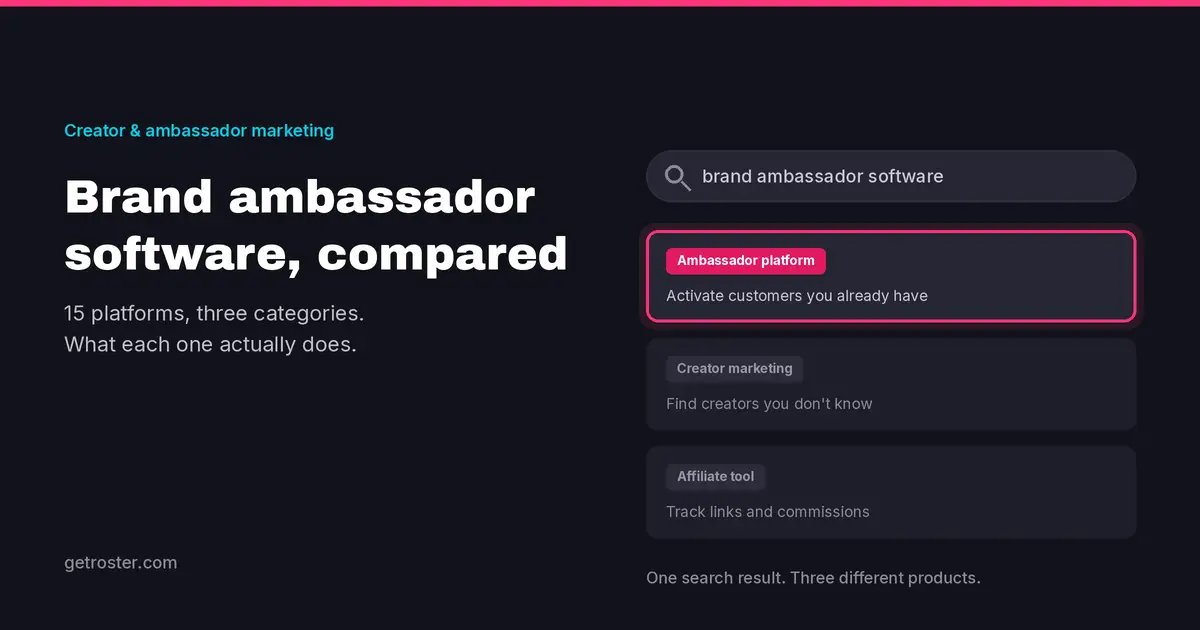
Short answer: "brand ambassador software" returns three different product categories. Ambassador platforms manage relationships, recruitment, rewards and content. Creator marketing platforms are built for finding creators you don't already know. Affiliate tools track links and commissions and stop there. Pick the category that matches the job first, then compare products inside it — most bad purchases are category errors, not product errors.
This guide sorts platforms by what they actually are, runs the real cost of running or migrating an ambassador program at DTC volume, and says plainly who each one fits. Including where we don't.
What's in this comparison
Three different products, one search result
Search "brand ambassador software" or "brand ambassador platform" and you get three categories mixed together.
Creator marketing platforms sell you a database of strangers and the tooling to reach them. Affiliate apps sell you links, codes, and payouts. Ambassador and community platforms sell you the machinery to activate people who already buy from you.
Picking the wrong category costs more than picking the wrong vendor inside one. A brand whose ambassadors are its own customers can spend a year paying for creator discovery it never opens.
The crowding is a symptom of where the money went. Goldman Sachs Research put the creator economy at roughly $250 billion in 2023, projected to approach $480 billion by 2027. Every vendor in an adjacent category has since repositioned toward that number, which is why a search for one thing returns three.
What to look for in ambassador software
Are you recruiting strangers or activating customers?
This is the fork, and everything else follows from it. If your best advocates are already in your Shopify customer list, discovery tooling is dead weight on the invoice. If nobody knows your brand yet, a platform built for activating existing customers has nothing to activate.
How does the platform charge on the sales it tracks?
Flat subscription, or subscription plus a cut of affiliate revenue. At small volume the difference is rounding. At DTC scale it isn't, and the arithmetic is below.
Can it run more than one program type in one place?
Ambassadors, affiliates, creators and gifted seeding have different workflows but the same reporting question at the end: what did this drive.
Does it capture content rights at submission?
If you plan to run fan content in paid social, email, or on product pages, licensing has to be captured when the content comes in. Chasing rights retroactively across a hundred creators is a legal review you don't want.
How deep is the Shopify connection?
Order-level attribution and native discount code sync, not a third-party connector. Ask specifically about multi-store, because most Plus brands have more than one. Check the integration list against your actual stack, not just your cart.
A proxy worth using: pull the vendor up on the Shopify App Store and read the one and two star reviews before the five star ones. Merchants describe integration failures there in more detail than any sales call will, and the review volume tells you how many Shopify stores are actually running the thing.
Does it handle disclosure?
Ambassadors posting about your products are making endorsements, and the FTC's Endorsement Guides put responsibility on the brand for material connections being disclosed. Ask how the platform prompts and monitors it. Most vendors will not raise this unprompted.
The math nobody runs before signing
Percentage-of-sales pricing is the thing most brands get wrong, and it gets more wrong the better your program performs.
Refersion's published entry is $39 a month plus 3% of affiliate-generated sales, with the rate stepping down at higher tiers. Impact.com applies 2.5% on partner-driven sales. Both are reasonable at $50k of tracked revenue.
Now run it at Shopify Plus volume. A brand doing $20M with 10% of revenue moving through advocates is $2M in tracked sales. At 3% that's $60,000 a year in transaction fees, sitting on top of subscription, growing every quarter your team does its job well.
That's the part to sit with. Under a percentage model, the invoice for your ambassador program is indexed to the success of your ambassador program. You are paying more precisely when the channel starts working.
Flat pricing inverts it. Cost holds, contribution margin on the channel improves as volume grows, and the CAC you report on referred revenue keeps falling instead of flattening. For a Plus brand running an always-on program, that curve is the whole argument.
None of which makes percentage pricing wrong at every stage. If you're testing whether advocacy works at all and tracked revenue is under six figures, a percentage tool is cheaper and the vendor only wins when you do. Just model it against next year's number before you sign a term.
Quick comparison
| Platform | Category | Pricing model | Fits |
|---|
| Roster | Ambassador and community | Flat subscription, no percentage on affiliate sales | Shopify and Plus brands activating existing customers across ambassador, affiliate, creator and seeding programs in one place |
| GRIN | Creator marketing | Self-serve tiers, $0 to $1,500/mo, month to month, no take rate on affiliate GMV | Brands whose bottleneck is finding creators they don't already know |
| Aspire | Creator marketing | Custom quote | Mid-market creator programs with an inbound application flow and a dedicated program manager |
| SocialLadder | Ambassador and community | Custom quote | Campus, field and event-driven programs needing a mobile-first ambassador app |
| Brandbassador | Ambassador and community | Custom quote | Gamified mission-based programs where engagement volume is the goal |
| Buzzbassador | Ambassador and community | Published Shopify app tiers | Small Shopify programs that need tracking, not a platform |
| Impact.com | Affiliate tracking | 2.5% on partner-driven sales | Enterprise programs managing affiliates, publishers, agencies and B2B referral partners together |
| Refersion | Affiliate tracking | From $39/mo + 3% of affiliate-generated sales, rate drops at higher tiers | Brands that want affiliate attribution and nothing else |
| Superfiliate | Affiliate tracking | Published tiers | Brands wanting co-branded creator landing pages rather than plain links |
| Social Snowball | Affiliate tracking | Published tiers, entry plan takes 3% of affiliate-generated revenue | Shopify brands converting customers to affiliates at checkout |
| Awin | Affiliate network | Access fee plus a percentage of partner-driven sales | Brands that want access to an existing publisher base |
| LeadDyno | Affiliate tracking | Tiers capping active affiliates, from around 50 on entry | Small programs with a single commission structure |
| UpPromote | Affiliate tracking | Free tier plus published tiers | Early stores testing whether an affiliate motion works |
| GoAffPro | Affiliate tracking | Free tier with unlimited affiliates | Brands launching a first affiliate program at zero cost |
| Shopify Collabs | Affiliate tracking | Free to install plus a payout fee | Merchants wanting a zero-cost first step inside the Shopify admin |
Every dollar figure here comes from the vendor's own pricing page, checked in August 2026. Third-party aggregators in this category disagree with each other badly, and several are still publishing rates their subjects abandoned this year.
Built to activate people who already know you — customers, fans, applicants. Recruitment, tiers, rewards, content and payouts in one place.
Roster
Roster runs ambassador, affiliate, creator and seeding programs from one platform, built for Shopify and DTC brands. A customer applies through your branded recruitment form, gets a tracked link and discount code, moves through points and milestones as they perform, and gets paid without anyone chasing it. What's missing in most programs is never the demand — it's the machinery to route it.
Pricing is flat subscription with no cut of affiliate-driven sales, which is the structural reason the cost curve above bends the way it does.
For Plus specifically: multi-store attribution, discount code generation at volume, and the fact that Plus GMV is exactly where percentage fees do the most damage. Case studies here if you want to see programs running at that size, and the full feature set here.
Roster installs natively from the Shopify App Store, where it holds a 4.8 rating with a free trial, so you can run a program against your real order data before committing. Applying the test above to ourselves: go read those reviews rather than taking this page's word for it.
Where we're the wrong call: if your core problem is finding creators you've never heard of, buy a discovery platform. Roster doesn't sell a creator database and won't pretend the workaround is elegant.
SocialLadder
Built around a mobile app for ambassadors, with tasks, challenges and push notifications. If your program has a physical component — campus reps, event teams, retail activations — this is the one designed for it. Quote-based pricing.
Less of a fit if you want published pricing and a self-serve start.
Brandbassador
Mission-based and heavily gamified. Brands set missions, ambassadors complete them, engagement volume goes up. It manages the community you bring rather than sourcing one. Quote-based.
Needs a team with time to design missions. Without that, the gamification sits idle.
Compare Roster and Brandbassador side by side →
Buzzbassador
A lighter Shopify-native option for tracking ambassador sales and commissions. Fewer moving parts, priced accordingly. Good first tool for a small program. You'll outgrow it around the time content and seeding become part of the job.
Built outbound-first. You search a database, reach out, negotiate, run campaigns. The point is acquiring creators you don't have.
GRIN
A creator management platform for ecommerce with a large database and deep Shopify integration. GRIN moved to self-serve pricing in 2026: five monthly tiers from free up to $1,500, month to month, no annual contract, no required sales call. Plans meter credits consumed by Gia, their AI assistant, rather than charging per seat, and the hands-on workspace comes in from the $500 tier. GRIN states there's no take rate or transaction fee on affiliate GMV.
Worth being straight about this: on price structure, GRIN is now competitive. The real question between GRIN and a platform like ours isn't cost — it's whether your growth comes from creators you find or customers you already have.
Compare Roster and GRIN side by side →
Aspire
Inbound and community-first. You post a brief, creators apply. That suits structured content pipelines better than cold outreach. Custom quote with no published tiers, so budget a procurement cycle.
Links, codes, attribution, payouts. Cheapest entry, narrowest scope. Most don't touch content, community or product seeding.
Impact.com
Enterprise partnership infrastructure. It manages affiliates, publishers, agencies, B2B referral partners and creators in one system, with contract management and attribution built for complex programs. Applies 2.5% on partner-driven sales.
Compare Roster and Impact.com side by side →
Refersion
First-party affiliate attribution with strong Shopify support and unlimited affiliates on every plan. From $39 a month plus 3% of affiliate-generated sales, with the percentage decreasing as you scale.
Good if affiliate tracking is genuinely all you need. Run the percentage against your projected tracked revenue first.
Compare Roster and Refersion side by side →
Superfiliate
A creator commerce platform whose defining feature turns every creator link into a co-branded landing page rather than a plain tracked URL. That suits brands where the creator's own audience expects a destination, not a redirect.
Compare Roster and Superfiliate side by side →
Awin
An affiliate network rather than a platform. You pay for access to its publisher base, and Awin takes a percentage of every partner-driven sale on top of the commission you pay the partner.
Compare Roster and Awin side by side →
UpPromote
A free tier plus published paid tiers, aimed at early stores testing whether an affiliate motion works at all. Broad Shopify install base, narrow scope beyond tracking and payouts.
GoAffPro
A free tier with unlimited affiliates, which is hard to argue with for a brand launching its first program. If you're testing whether affiliate marketing works for you at all, this is a good option.
Compare Roster and GoAffPro side by side →
Shopify Collabs
Shopify's native creator tool. Free to install, with a fee applied to payouts, living inside the admin you already use. A reasonable zero-cost first step. Program structure, ambassador tiers and content licensing aren't what it's for.
Compare Roster and Shopify Collabs side by side →
Which type of brand each one fits
The category question above sorts by what the product does. This sorts by who you are.
DTC and ecommerce brands past $1M
You almost certainly have advocates already in your customer list, which makes activation the job rather than discovery. Look for order-level Shopify attribution, one system covering ambassadors and affiliates, and flat pricing — at this revenue a percentage model starts compounding against you. Roster, Social Snowball and Buzzbassador are built for this shape; GRIN and Aspire are solving a different problem.
Shopify Plus and enterprise
Multi-store rollup, code generation at volume, and contract terms matter more than features. This is where percentage fees become the largest line-item difference between vendors, and where Impact.com's contract management earns its complexity if you're managing publishers and agencies alongside creators.
Retail and multi-location
If advocates are tied to physical locations or field teams, you need mobile-first task management more than affiliate tracking. SocialLadder is purpose-built here. Attribution gets harder when sales happen in-store, so ask specifically how offline conversions are credited.
Small programs and first launches
Under about twenty ambassadors, a free tier or a lightweight tracker is the right call — GoAffPro, UpPromote or Shopify Collabs. Buy the platform when manual admin starts costing more than the subscription, not before. The playbook covers running it manually first.
Ambassador management rather than affiliate tracking
If the job is managing relationships — tiers, rewards, content, seeding, community — rather than counting clicks, the affiliate category will frustrate you within two quarters. That's the distinction the FAQ below opens with, and it's the most common category error in this market.
Roster runs ambassador, affiliate, creator and seeding programs from one platform, with no percentage taken on the revenue your advocates drive. 1.5 million referred orders and $250 million in referred revenue tracked to date. See how ambassador programs run on Roster.
Get a Roster demo →
What Shopify Plus brands should ask that smaller brands don't
Four things change once you're on Plus.
Multi-store attribution. Plus brands usually run more than one storefront, often across regions. Ask whether ambassador attribution rolls up across stores or fragments per store, because fragmented is the default and it's discovered late. Check the vendor's integration coverage before the demo, not during it.
Percentage fees at real GMV. Covered above. This is the single largest line-item difference between vendors at Plus volume, and it never shows up on a feature comparison table.
Codes at volume. A program with thousands of active advocates means thousands of unique discount codes generated, synced and expired on schedule. Ask how that's handled and what the ceiling is.
Who operates it. Plus brands run lean marketing teams against large catalogues. The relevant question isn't what the platform can do, it's how many hours a month your team spends running it. Get that number from a reference customer, not a sales deck, and ask what the reporting actually produces without manual assembly.
Worth remembering why any of this matters: word of mouth drives a large share of purchasing decisions, per McKinsey's work on measuring it. The software is only the machinery for capturing something that was already happening.
Frequently asked questions
What's the difference between ambassador software and affiliate software?
Affiliate software tracks links, codes and commissions. Ambassador software adds the relationship layer: recruitment, tiers, rewards, content collection and licensing, seeding, community. Most brands start with affiliate tracking and outgrow it when content becomes part of the program.
Do I need separate tools for ambassadors, affiliates, and influencers?
No, and splitting them splits your attribution. Once referral revenue lives in one system and content lives in another, "which content drove sales" stops being answerable.
How much does brand ambassador software cost?
Free Shopify apps at one end, six-figure enterprise contracts at the other. The number that matters isn't the monthly fee, it's the total including any percentage taken on tracked sales. A $39/month tool taking 3% of a $2M program costs $60,000 a year more than the sticker.
Can I run an ambassador program without software?
Under about twenty ambassadors, yes. Past that, manual attribution and payouts eat more staff hours than the software costs. Our brand ambassador playbook covers the manual version if you want to test the motion first.
Which ambassador platform works best with Shopify Plus?
Look for native order-level attribution, discount code sync and multi-store rollup rather than a connector in the middle. Roster, Social Snowball, Buzzbassador and Shopify Collabs are Shopify-native. GRIN and Refersion integrate well alongside other platforms.
What's the best brand ambassador software for a DTC brand?
For a DTC brand past $1M, the deciding factors are usually order-level Shopify attribution, whether ambassadors and affiliates live in one system, and whether pricing takes a percentage of tracked sales. Those three narrow the field faster than any feature list.
Is ambassador software the same as ambassador management software?
The terms are used interchangeably, but "management" usually signals the relationship side — tiers, tasks, rewards, content — rather than pure sales tracking. If that's the job you're hiring for, the affiliate category will come up short.