Every Shopify affiliate app looks the same on its App Store listing. Personal links, discount codes, commission tracking, a payout button. The listing does not tell you the thing that decides what this costs you in two years, which is whether the app charges a percentage of the revenue your affiliates generate.
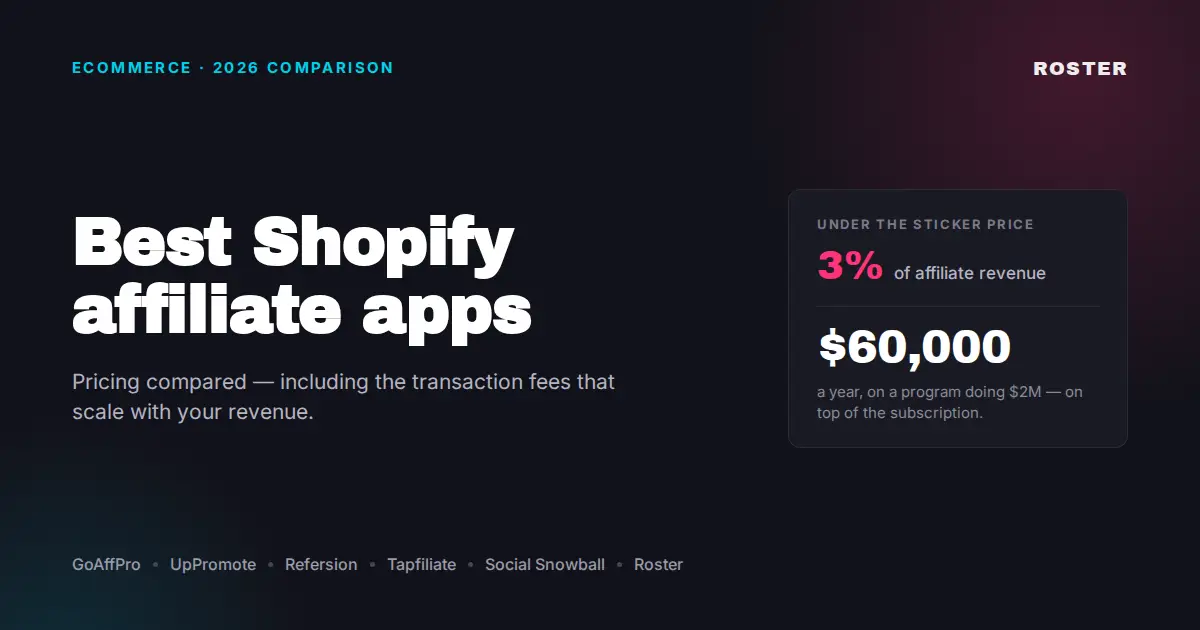
That single pricing decision separates the apps below more than any feature does. At $2M in affiliate-driven revenue, a 3% transaction fee is $60,000 a year on top of the subscription. The same program on a flat monthly fee costs what the plan costs. Nothing about the software changed — only the pricing model.
Short answer: Shopify affiliate apps fall into three groups. Entry apps (GoAffPro, UpPromote) are cheap and fine for a first program. Tracking-first apps (Refersion, Tapfiliate) do links, commissions and payouts well and stop there. All-in-one platforms (Social Snowball, Roster) add ambassador recruiting, content and UGC rights on top of affiliate tracking. Pick the group that matches the program you are actually running, then compare inside it — and check the transaction fee before the feature list.
What this guide covers
- The three categories of Shopify affiliate app
- Pricing compared, including transaction fees
- What each app is actually built for
- The percentage-fee math at your revenue
- How to choose
The three categories, and why the category matters more than the app
Most regrettable purchases in this space are category errors, not product errors. A brand picks a link-tracking tool, runs it for a year, then discovers it needs to recruit customers into an ambassador program, collect content, and hold usage rights — and none of that exists in the tool. The app was not bad. It was the wrong category.
Entry apps
Built to get a program live quickly and cheaply. Affiliate signup, links, codes, commission rules, a basic dashboard. Right for a brand testing whether affiliates work at all. You outgrow them when the program needs structure — tiers, segments, content, proof of incremental revenue.
Tracking-first apps
Mature affiliate infrastructure. Solid attribution, flexible commission logic, product-level tracking, real payout rails, API access. Right for a brand running a conventional affiliate program with publishers and coupon partners. They do not manage relationships, and they do not handle content or usage rights.
All-in-one ambassador and affiliate platforms
Affiliate tracking plus the work around it: recruiting ambassadors out of your own customer list, campaign and seeding workflows, UGC collection with usage rights, tiering, and revenue attribution across all of it. Right for a brand whose program is people — customers and creators who post — rather than publishers who place links.
Shopify affiliate apps compared
Pricing checked against each vendor's own pricing page on September 18, 2026. Transaction fees are charged on affiliate-generated revenue, on top of the monthly subscription. Vendors change pricing; confirm before you buy.
| App | Entry price | Transaction fee | Category |
|---|
| GoAffPro | Free; Premium $49/mo; Business from $99/mo | None listed | Entry |
| UpPromote | Free; Growth $29.99/mo; Professional $89.99/mo; Enterprise $199.99/mo | 2% on Growth, 1.5% on Professional, 1% on Enterprise | Entry |
| Refersion | Launch $29/mo; Growth $159/mo; Scale custom | 3% on Launch, 2% on Growth; Scale is flat | Tracking-first |
| Tapfiliate | Launch $89/mo; Scale $179/mo; Enterprise custom | None; charges click and conversion overages instead | Tracking-first |
| Social Snowball | Snow Day from $249/mo; Blizzard from $899/mo | 3% on Snow Day; none on Blizzard | All-in-one |
| Roster | From $599/mo | None | All-in-one |
What each one is actually built for
GoAffPro
The cheapest credible way to put an affiliate program on a Shopify brand. A free tier that genuinely works, and paid tiers that stay inexpensive as you scale. No percentage of sales listed on any tier, which makes it unusually cheap at volume for what it is.
What you give up is depth. Reporting is thin, the ambassador side is basic, and there is no content or usage-rights layer. It is a good first program and a poor tenth one.
Roster vs GoAffPro →
UpPromote
The most-installed affiliate app on Shopify, and the tiering is worth reading carefully: the percentage fee falls as you move up plans — 2% on Growth, 1.5% on Professional, 1% on Enterprise. That structure means the plan that looks expensive is often the cheaper one once you have real referred revenue.
Strong on the mechanics — multiple programs, anti-leak discount codes, PayPal auto-pay. Creator discovery is a paid add-on rather than part of the platform.
Refersion
One of the longest-running affiliate platforms in ecommerce, and it shows in the attribution work — first-party tracking, product-level commissions, 30+ integrations, a real API. If you are running a conventional affiliate program with publishers, this is competent infrastructure.
The pricing deserves attention. Launch is $29/mo but carries a 3% fee on affiliate-driven sales, which is the highest percentage in this comparison. Growth halves the subscription pain and drops the fee to 2%. Only the custom Scale tier removes the percentage.
Roster vs Refersion →
Tapfiliate
The one app here that prices on usage rather than on your revenue. No percentage of sales; instead you buy clicks and conversions, with overages beyond the plan. Launch includes 50 affiliates, 5,000 clicks and 500 conversions a month; Scale opens that to unlimited affiliates and 100,000 clicks.
That model is predictable and it does not punish a program that works. It is also not Shopify-specific — Tapfiliate serves SaaS and subscription businesses too, so some of the product is not aimed at ecommerce.
Social Snowball
Built for ecommerce and aimed squarely at turning customers into affiliates, with a heavy focus on payouts — the platform advertises over 700 payout redemption methods. The two tiers express the pricing question plainly: Snow Day starts at $249/mo plus 3% of affiliate-generated revenue, Blizzard starts at $899/mo with no commission fee.
If your program works, Snow Day gets expensive in a way that is easy to underestimate at signup. Run the math in the next section before choosing the cheaper-looking tier.
Roster vs Social Snowball →
Roster
Roster is ours, so take the description as positioning and check it against the alternatives. It is built for brands whose growth comes from their own customers — recruiting ambassadors out of the customer list first, then widening to affiliates and creators, on one platform rather than four tools.
That means affiliate links and codes, commissions and automated payouts, plus the parts that usually live elsewhere: ambassador recruiting and tiering, campaign and seeding workflows, UGC collection with usage rights, and attribution that ties revenue back to the person who drove it. Pricing is flat monthly from $599 with no percentage of affiliate revenue.
It is the wrong fit for a brand under about $1M in revenue, or one that wants a $29 app to test an idea. The wider ambassador software comparison covers where it sits against creator platforms too.
The percentage-fee math, at your revenue
This is the calculation to run before you compare a single feature. Take the affiliate-driven revenue you expect twelve months from now, not today's, and apply each app's percentage to it.
| Affiliate revenue per year | At 3% | At 2% | At 1.5% | At 1% |
|---|
| $250,000 | $7,500 | $5,000 | $3,750 | $2,500 |
| $500,000 | $15,000 | $10,000 | $7,500 | $5,000 |
| $1,000,000 | $30,000 | $20,000 | $15,000 | $10,000 |
| $2,000,000 | $60,000 | $40,000 | $30,000 | $20,000 |
| $5,000,000 | $150,000 | $100,000 | $75,000 | $50,000 |
Those figures sit on top of the monthly subscription, and they scale with your success. A program doing $2M through affiliates on a 3% plan is paying $60,000 a year in transaction fees before the subscription — more than most flat-fee platforms cost outright.
The honest counterpoint: at low volume the percentage model is cheaper, and it should be. A brand doing $250,000 in affiliate revenue pays $7,500 at 3%, which beats a $599/month flat fee. The crossover is the thing to find. Work out where your program's revenue makes a flat fee cheaper, then check whether you expect to cross it inside the contract you are about to sign.
Working out which category you need?
A 30-minute call is usually enough to tell whether an ambassador program or a straight affiliate program fits what you are trying to build. Book a demo →
How to choose
Start with the program, not the app. Are you recruiting publishers and coupon partners who place links, or customers and creators who post? The first is an affiliate program and a tracking-first app will serve it. The second is an ambassador program, and affiliate tracking alone will leave you running content, seeding and rights in spreadsheets.
Then check the fee against your twelve-month revenue. Not today's. The percentage model prices your success, so the decision should be made on where the program is going.
Then check what happens to content. If ambassadors post, someone has to collect the content, hold usage rights, and get it into paid social. Apps that stop at link tracking leave that work to you.
Then check attribution you can defend. The question that ends most programs is a CFO asking what the program actually drove. If the answer requires assembling four exports by hand every month, the program does not survive a budget review.
FAQ
What is the best affiliate app for Shopify?
There is no single best one, because the apps solve three different jobs. For a first program on a small budget, GoAffPro and UpPromote are the sensible starting points. For conventional affiliate infrastructure, Refersion and Tapfiliate. For a customer-led ambassador program that also needs content and usage rights, Social Snowball and Roster. Pick the category first.
Is there a free Shopify affiliate app?
Yes. GoAffPro and UpPromote both have free tiers that run a working program. They are limited on reporting and program structure, but they are a legitimate way to find out whether affiliates work for your brand before committing budget.
What is a transaction fee on an affiliate app?
A percentage of the revenue your affiliates generate, charged monthly on top of the subscription. In this comparison it ranges from 1% to 3% depending on app and tier. It is the single largest cost difference between these platforms at scale, and it is often shown in smaller type than the monthly price.
Can one app run both an affiliate program and an ambassador program?
Some like Roster can. The distinction that matters is whether the platform treats them as separate program types with different rules, rewards and reporting, or simply as one affiliate list with a different label. If you intend to run both, ask to see them configured separately before you buy.
Does Shopify have its own affiliate tool?
Shopify Collabs handles creator gifting and affiliate commissions inside the Shopify admin, at no additional platform cost. It is a reasonable starting point for creator gifting. It is thinner on program structure, ambassador recruiting and attribution than the dedicated apps here. Roster vs Shopify Collabs covers the difference in detail.
How much should an affiliate program cost to run?
Software is the smaller half. Budget for the commission you pay out, the software, and the person running it. What an ambassador program costs breaks the full picture down.
See what the numbers look like across live programs.
The Ambassador Marketing Benchmarks 2026 report covers what baseline and top-quartile programs actually produce, drawn from live program data.