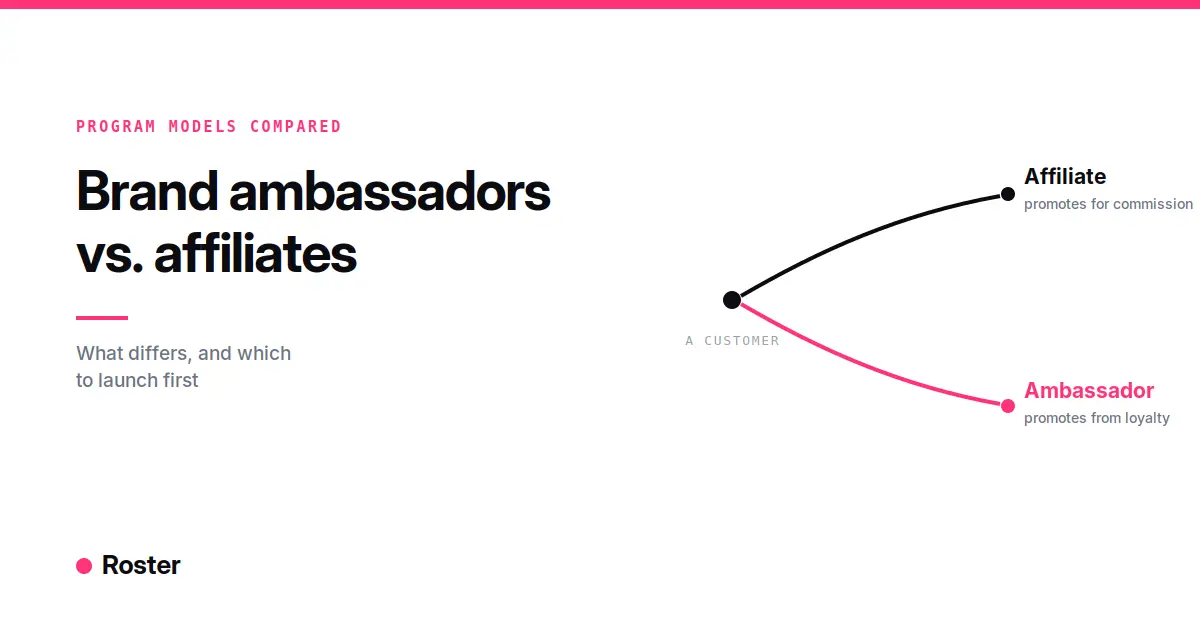
Short answer: if your product has repeat buyers who already post about it, start with ambassadors. If you’re trying to reach audiences that have never heard of you, start with affiliates. Most brands past their first few million in revenue eventually run both, and the sequence matters more than the choice.
The longer answer is that these two words describe different relationships, not different job titles, and the confusion costs real money. Brands set up affiliate tooling for a customer-advocacy program, then wonder why nobody posts. Or they recruit ambassadors and pay them like affiliates, then wonder why the good ones drift away.
What’s the difference between an affiliate and a brand ambassador?
An affiliate promotes your product for a commission on sales they drive —
the relationship is transactional and performance-based. A brand ambassador
represents your brand over time, usually combining commission with free product,
content creation, and an ongoing relationship. Affiliates optimize for conversions;
ambassadors build long-term advocacy.
The core distinction
An affiliate promotes your product to an audience they’ve built, for a commission. The relationship is transactional by design, and that’s not a criticism. Affiliates are professionals. They usually work with several brands in a category, they know their conversion rates, and they’ll shift attention to whichever program pays best.
A brand ambassador is usually already your customer. They post because they like the product, and the incentive is a reason to keep going rather than the reason they started. Rewards skew toward product, early access, status, and store credit as much as cash.
The test that resolves most cases: would this person still mention your brand if the commission went to zero? If yes, they’re an ambassador and you should treat them as one. If no, they’re an affiliate, and there’s nothing wrong with that.
“We have loyal users but no easy way to help them spread their love for our products.”
Taylor W., VP of Marketing and Ecommerce, Caraway
Side by side
|
Affiliates |
Brand ambassadors |
| Who they are |
Publishers, creators, deal sites, and media partners with an existing audience |
Existing customers, usually with small to mid-size followings |
| Why they promote |
Commission |
Genuine preference, with rewards as reinforcement |
| Audience |
Strangers to your brand |
Friends, family, and followers who trust them personally |
| Typical reward |
Percentage of sale, sometimes tiered |
Mix of commission, free product, store credit, status, early access |
| Content |
Usually theirs to keep; you may have no usage rights |
Regular UGC you can license and reuse if the program is set up for it |
| Relationship length |
Varies. Often as long as the payout stays competitive |
Long, and tends to deepen |
| Volume per person |
Higher revenue per partner, fewer partners |
Lower revenue per person, many more people |
| Main risk |
Attribution disputes, coupon leakage, brand-safety mismatches |
Program decay. Ambassadors go quiet if nobody engages them |
| What it costs you |
Commission on sales, plus platform fees |
Product cost, reward cost, and program management time |
Swipe the table to see both columns →
One row deserves expanding, because it’s where the most money hides.
Content rights. An affiliate writing a review owns that review. An ambassador posting about your product also owns it, unless your program captures a license at submission. Brands that get this right end up with a reusable content library from a program they were already paying for. Brands that don’t end up asking permission post by post, or quietly using content they don’t have rights to.
The cost structures are not comparable
Affiliate cost is variable and predictable: a percentage of what they drive, plus whatever the tracking platform charges. If the program stalls, cost goes to near zero.
Ambassador cost is mostly fixed and front-loaded: product you ship, rewards you fund, and the hours someone spends running it. That cost exists whether or not the program performs in month one.
This makes ambassadors look expensive early and cheap later. Affiliate programs invert that, particularly if your platform takes a percentage of tracked sales on top of subscription — at DTC volume, that layer grows precisely as the channel starts working. We ran that math in detail in our guide to ambassador platforms.
The practical implication: judge an ambassador program on a longer horizon than an affiliate program. Ninety days is enough to know whether affiliates are converting. It isn’t enough to know whether an ambassador community is compounding.
Which to run first
Start with ambassadors if
You have repeat purchase behavior, customers already tag you without being asked, your product is visual or demonstrable, and you want content as well as revenue.
Start with affiliates if
Your category has established publishers and comparison sites, your AOV is high enough to fund meaningful commissions, purchases are considered rather than impulsive, and you need reach into audiences that don’t know you.
Run both if
You’re past roughly $5M and already doing one well. Affiliates reach people who’ve never heard of you; ambassadors convert people who’ve heard of you but haven’t bought.
That last one has a catch. Running them in two separate tools splits your reporting, and you lose the ability to see that an affiliate drove first click and an ambassador closed it. We cover the structural side in how DTC brands build scalable ambassador and affiliate programs.
What’s the same for both
Two things people assume differ, and don’t.
Disclosure obligations. Anyone promoting your product in exchange for commission, free product, or any other benefit is making an endorsement. Under the FTC’s Endorsement Guides, responsibility for disclosing that material connection sits with the brand, not just the individual. Free product counts. Store credit counts. Build disclosure into your terms and your program prompts for both groups.
Attribution requirements. Both need unique trackable links and their own discount codes, tied to real orders. If you can’t say which individual drove which sale, you can’t pay fairly — and unfair payment is how good partners of either type leave.
How to actually run each one
For affiliates: competitive commission rates, clean creative assets, reliable payouts, and a dashboard where they can see their own numbers without asking you. Affiliates optimize. Give them the data to optimize with.
For ambassadors: a low-friction way in via a branded application form, product seeding that fulfills without manual work, points and milestones so progress is visible, and someone who actually responds to them. The failure mode for ambassador programs is never the incentive design. It’s silence.
Whichever model you pick, the benchmark is the same — the cost of acquiring that customer through paid channels instead.
Frequently asked questions
Is a brand ambassador the same as an affiliate?
No. Affiliates promote to an audience they’ve built, motivated by commission. Ambassadors are usually existing customers who promote to people who know them personally, motivated by genuine preference and reinforced by rewards. The overlap is that both get trackable links and both get paid.
Can brand ambassadors earn commission?
Yes, and most do. The difference isn’t whether they’re paid — it’s that commission is one part of a reward mix that also includes free product, store credit, early access, and status, rather than the whole relationship.
Which drives more revenue, ambassadors or affiliates?
Affiliates usually drive more revenue per partner. Ambassador programs drive more in aggregate at scale, because you can have hundreds or thousands of them, and they produce content alongside the sales.
Do I need separate software for each?
You shouldn’t. Running them in separate tools fragments attribution and hides the interaction between the two. A platform that handles both keeps one record of who drove what.
How many ambassadors do I need to start?
Twenty-five to fifty engaged customers is a real program. Volume matters less than picking people who already post and giving them a reason to keep going.
Run both without splitting your reporting
Roster runs ambassador, affiliate, creator, and seeding programs from one platform, with no percentage taken on the revenue your partners drive. See ambassador program software and ecommerce affiliate software.
1.5 million referred orders · $250 million referred revenue · 1.7 million UGC posts