Why Influencer Contracts Matter More Than Ever
Influencer marketing has shifted from posts to performance assets.
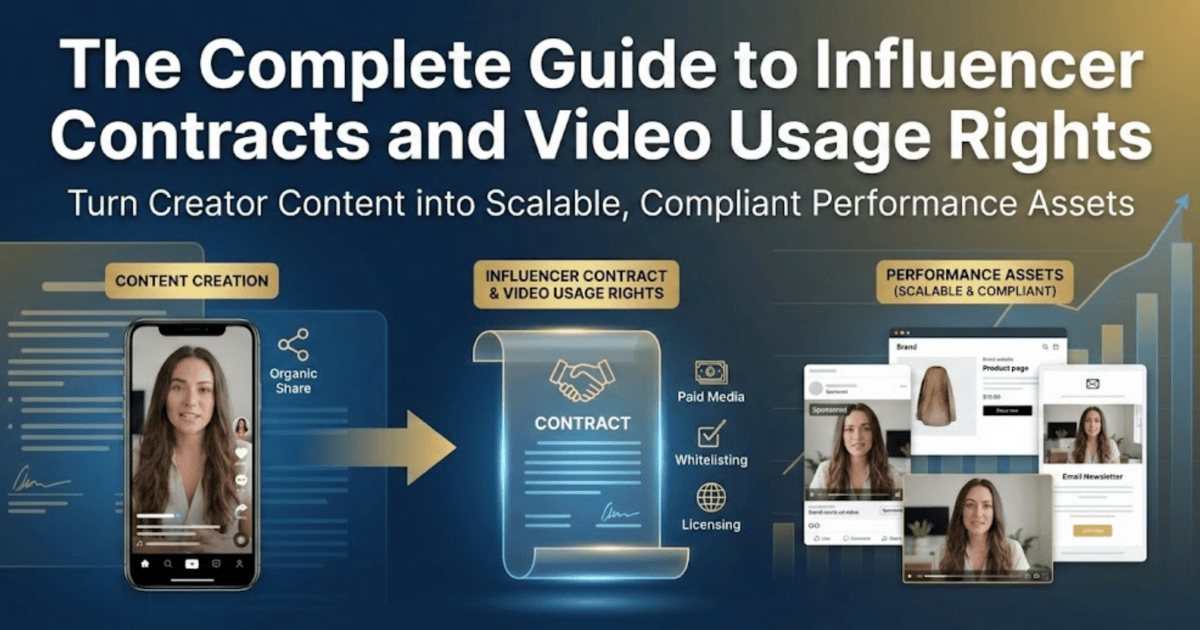
Today, creator videos are reused across:
- Paid social ads
- Email and SMS campaigns
- Product pages and landing pages
Yet many DTC brands still operate with vague or incomplete agreements—creating legal risk and limiting scale.
According to Shopify, 50% of marketers can’t accurately measure influencer ROI, often because content rights and attribution are fragmented.
Source: Shopify — https://www.shopify.com/research/influencer-roi-tracking
Marketing implication: If you don’t own usage rights, you don’t own performance.
Business impact: Lost leverage, limited ROAS, and avoidable compliance risk.
What Usage Rights Actually Mean (and Why Brands Get This Wrong)
Usage rights define how, where, and for how long a brand can use creator content.
Common misconceptions:
- “If we paid for it, we own it” (false)
- “Organic permission includes paid ads” (false)
Without explicit licensing, most creator content is legally limited to organic posting only.
This matters because, according to McKinsey, word-of-mouth and peer-driven content influences 20–50% of all purchasing decisions—making UGC one of the most valuable performance assets a brand can deploy.
Source: McKinsey — https://www.mckinsey.com/business-functions/marketing-and-sales/our-insights/the-science-behind-the-effectiveness-of-word-of-mouth
Marketing implication: Rights determine scale.
Business impact: The difference between reusable media and one-time content.
Core Clauses Every Influencer Contract Must Include
1. Content Ownership vs Licensing
Most influencer contracts should grant:
- A license to use the content, not ownership transfer
- Clear terms defining scope and duration
According to Harvard Business Review, brands that build long-term, trust-based creator relationships outperform transactional arrangements with 9.2% higher ROI per campaign.
Source: HBR — https://hbr.org/2022/03/does-influencer-marketing-really-pay-off
Marketing implication: Fair licensing builds better creator relationships.
Business impact: Sustainable access to high-performing content.
2. Platform and Channel Rights
Contracts should explicitly state whether content can be used on:
- Paid social ads
- Brand websites
- Email and SMS
- Marketplaces and landing pages
Ambassador and creator content raises brand awareness 2.1× more efficiently than traditional influencer posts, according to Shopify.
Source: Shopify — https://www.shopify.com/research/creator-marketing-strategy
3. Duration and Renewal Terms
Usage rights should define:
- Start and end dates
- Renewal options
- Buyout clauses if content performs exceptionally well
Marketing implication: Time-bound rights protect both parties.
Business impact: Cost control with upside flexibility.
How to Structure Video Usage Rights for Scale
1. Separate Posting From Usage
Best-in-class DTC brands separate:
- Content creation (posting obligation)
- Content usage (where and how the brand can reuse it)
This unlocks reuse across the funnel without renegotiating every asset.
According to Bain & Company, advocacy-led brands achieve 1.6× higher profit margins than brands relying solely on performance advertising.
Source: Bain — https://www.bain.com/insights/the-value-of-wowing-your-customers/
2. Build Paid Media and Whitelisting Rights In
If you plan to:
- Run ads from creator handles
- Use content in paid social
You need explicit paid media and whitelisting rights.
Brands emphasizing trust-based advocacy improve profitability margins by up to 30% compared to high-CPA ad models, according to McKinsey.
Source: McKinsey — https://www.mckinsey.com/capabilities/growth-marketing-and-sales/our-insights
Marketing implication: Paid usage rights turn UGC into a growth lever.
Business impact: Higher ROAS and creative efficiency.
3. Align Compensation With Rights
Usage rights should directly influence payment:
- Organic-only rights → lower cost
- Multi-channel + paid rights → higher compensation or bonuses
According to PwC, trusted, advocacy-led customer engagement allows brands to charge 15–25% price premiums without losing customers.
Source: PwC — https://www.pwc.com/us/en/services/consulting/library/consumer-trust.html
Marketing implication: Transparent rights pricing builds trust.
Business impact: Better creator participation and predictable margins.
From Organic Content to Paid Media: Avoiding Legal Risk
One of the most common mistakes brands make is boosting or repurposing content without rights clearance.
This exposes brands to:
- Takedown requests
- Legal disputes
- Platform compliance issues
As UGC becomes a core performance channel, rights management is no longer optional—it’s infrastructure.
Marketing implication: Compliance protects scale.
Business impact: Zero disruption to paid and lifecycle channels.
Key Takeaways
- Influencer contracts determine how much value you can extract from content
- Usage rights must be explicit, not assumed
- Paid media and whitelisting require separate permissions
- The best brands treat UGC rights as performance infrastructure
FAQ
Do brands automatically own influencer videos they pay for?
No. Usage rights must be explicitly granted in the contract.
How long should video usage rights last?
Typically 6–12 months, with renewal options for high-performing assets.
Do ambassadors need different contracts than influencers?
Yes. Ambassador agreements are longer-term and often broader in usage scope.
Can brands use UGC in ads without permission?
No. Paid usage requires explicit licensing to remain compliant.
Ready to stop losing value from your creator content?
Book a demo with Roster and see how DTC brands centralize influencer contracts, automate usage rights, and turn UGC into fully compliant, high-performing growth assets.