- Blog
- How Your Shopify Unboxing Experience Can Trigger Viral UGC and Become One of Your Most Powerful Growth Channels
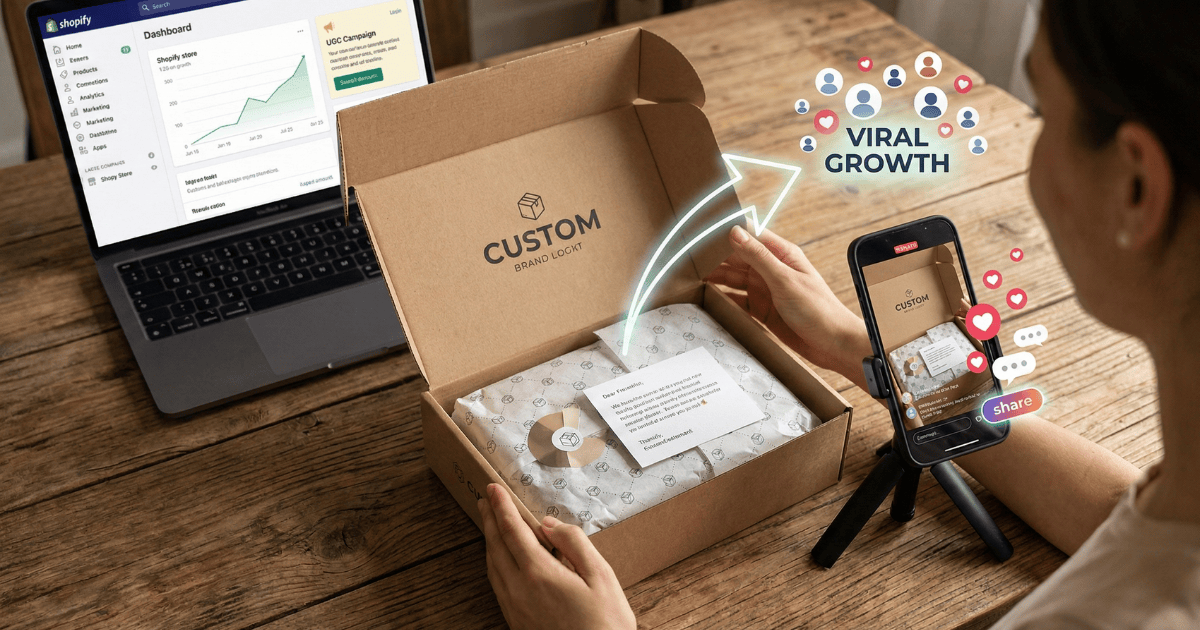


How Your Shopify Unboxing Experience Can Trigger Viral UGC and Become One of Your Most Powerful Growth Channels
Most Shopify founders obsess over the usual growth levers.
Paid media efficiency.
Landing page conversion rates.
Average order value.
Creative testing velocity.
All important.
Yet one of the highest impact growth drivers in modern ecommerce often gets treated like a procurement task.
Packaging.
Specifically, the unboxing experience.
Not the product itself.
Not the shipping speed.
The moment a customer opens the box and makes a near-instant decision about your brand.
Because in today’s social commerce environment, that moment does not just influence retention. It influences distribution.
Customers no longer just receive packages.
They document them.
When the experience is memorable, it turns buyers into broadcasters. When it is forgettable, it disappears into the recycling bin along with your opportunity for organic reach.
Let’s break down why unboxing has quietly become a marketing channel, what the research supports, and how Shopify brands can intentionally design packaging that generates user generated content instead of hoping it happens.
Packaging Is No Longer Operational. It Is Psychological.
First impressions are formed faster than most operators realize, and once formed, they are remarkably persistent.
Harvard Business Review explains that emotional connection is a stronger predictor of customer loyalty than satisfaction alone. Customers who feel emotionally connected to a brand are significantly more valuable over time.
Source: Harvard Business Review, “The New Science of Customer Emotions”
https://hbr.org/2015/11/the-new-science-of-customer-emotions
Packaging is frequently the first emotional touchpoint in a DTC relationship.
It answers silent questions immediately:
Did I make a smart purchase?
Is this brand premium?
Does this feel worth the price?
Those judgments often occur before the product is even used.
Word of mouth compounds the effect. Nielsen reports that 92 percent of consumers trust recommendations from people they know more than traditional advertising.
Source: Nielsen, Global Trust in Advertising
https://www.nielsen.com/insights/2015/global-trust-in-advertising-2015/
User generated content is simply modern word of mouth with dramatically higher distribution.
Packaging often determines whether that engine starts.
How Unboxing Became a Marketing Channel Without Brands Planning It
Humans are wired to enjoy anticipation and discovery.
Research published in Psychology and Marketing shows that anticipation and surprise heighten emotional response and improve memory formation.
Source: Psychology and Marketing Journal, Wiley Online Library
https://onlinelibrary.wiley.com/doi/10.1002/mar.21487
Social platforms gave that emotional spike a place to live.
Google has reported that unboxing videos help consumers visualize ownership and reduce purchase anxiety, which directly influences buying decisions.
Source: Think with Google, “How Unboxing Videos Influence Buying Decisions”
https://www.thinkwithgoogle.com/consumer-insights/unboxing-videos/
People do not watch unboxings because they are fascinated by corrugated cardboard. They watch because it provides reassurance and clarity.
When customers create that content, they are pre-selling your product to future buyers.
Free media is still media.
Why This Matters Even More for Shopify Brands
Retail brands compete for shelf space.
DTC brands compete for attention on a camera.
Your customer is effectively the storefront.
McKinsey research shows that companies leading in customer experience grow revenue faster than competitors that focus primarily on price or product features.
Source: McKinsey & Company, “Experience-Led Growth: A New Way to Create Value”
https://www.mckinsey.com/capabilities/growth-marketing-and-sales/our-insights/experience-led-growth-a-new-way-to-create-value
For Shopify operators, the unboxing moment is often the first physical proof that your brand is what you claimed it was online.
If the experience feels elevated, customers assume competence.
If it feels careless, customers assume shortcuts.
Fair or not, perception tends to become reality.
The Psychology Behind Why People Share Unboxing Content
Sharing is rarely random.
Research from Stanford Graduate School of Business demonstrates that people tend to share content that signals identity, taste, or status.
Source: Stanford Graduate School of Business, “Why People Share Things Online”
https://www.gsb.stanford.edu/insights/why-people-share-things-online
When someone posts an unboxing, they are expressing something about themselves as much as they are about your product.
A peer reviewed study in the Journal of Retailing and Consumer Services found that aesthetically pleasing packaging increases perceived value and emotional response, both of which correlate strongly with word of mouth behavior.
Source: Journal of Retailing and Consumer Services, ScienceDirect
https://www.sciencedirect.com/science/article/pii/S0969698919305406
People share what makes them look discerning.
Generic packaging rarely makes that cut.
Social Media Quietly Raised the Stakes
Before social platforms, a mediocre unboxing affected one household.
Now it can influence thousands.
Deloitte research shows that consumers place greater trust in authentic, peer created content than in traditional brand advertising.
Source: Deloitte, Digital Media Trends
https://www2.deloitte.com/us/en/insights/industry/technology/digital-media-trends-consumption-habits-survey.html
This explains why a slightly imperfect smartphone video often outperforms expensive studio creative.
Authenticity travels.
Packaging sets the stage for that authenticity.
No pressure.
What Actually Makes an Unboxing Worth Sharing
Viral moments are usually engineered, not accidental.
Across high growth DTC brands, several consistent principles appear.
Visual Distinction Signals Brand Quality Immediately
MIT neuroscience research suggests the human brain processes visuals dramatically faster than text.
Source: MIT News, “In the Blink of an Eye”
https://news.mit.edu/2014/in-the-blink-of-an-eye-0116
If your packaging blends in, the brain categorizes it as unremarkable almost instantly.
Distinct does not have to mean extravagant. It simply needs intention.
Customers subconsciously read packaging as a proxy for how seriously you take your business.
Personalization Builds Emotional Equity
McKinsey reports that 71 percent of consumers expect personalized interactions, and most become frustrated when those expectations are not met.
Source: McKinsey & Company, “Personalization at Scale”
https://www.mckinsey.com/capabilities/growth-marketing-and-sales/our-insights/personalization-at-scale
Personalization is less about handwriting thousands of notes and more about signaling relevance.
Customers understand scale.
They still appreciate effort.
Surprise Strengthens Memory
Unexpected positive moments are more memorable than predictable ones.
Source: Psychology and Marketing Journal
https://onlinelibrary.wiley.com/doi/10.1002/mar.21487
Surprise does not require extravagance. It requires thoughtfulness.
A clever insert.
A layered reveal.
Messaging that sounds like a human wrote it.
Adults enjoy discovery just as much as children. We are simply more subtle about it.
Functionality Protects Trust
The National Retail Federation consistently identifies damaged goods as a major driver of dissatisfaction and returns.
Source: National Retail Federation Research
https://nrf.com/research
A beautiful unboxing followed by a broken product is memorable for reasons you do not want.
Protection is part of the brand experience.
Ignoring it is expensive.
Shareability Should Be Designed Intentionally
People share content that enhances how others perceive them.
Source: Stanford Graduate School of Business
https://www.gsb.stanford.edu/insights/why-people-share-things-online
Ask one simple question during packaging reviews:
Would someone feel proud posting this?
If the answer is uncertain, revisit the design.
Organic reach favors brands that make customers look good.
Packaging Also Drives Retention, Not Just Acquisition
Retention is often framed as a product challenge, but experience plays a major role.
Bain & Company found that increasing customer retention by just five percent can boost profits by 25 to 95 percent.
Source: Bain & Company, “The Value of Online Customer Loyalty”
https://www.bain.com/insights/the-value-of-online-customer-loyalty/
Memorable first experiences increase repeat purchase probability.
Repeat customers are cheaper than new ones.
Your finance team will agree enthusiastically.
The Strategic Gap Many Shopify Brands Leave Open
Here is where many companies stop.
They improve packaging.
They feel proud of it.
Then they wait for customers to talk.
Waiting is not a system.
High growth brands pair thoughtful packaging with structured ambassador programs that multiply exposure.
Instead of one unboxing generating one impression, it generates dozens.
Advocacy becomes predictable rather than accidental.
Turning Unboxing Into a Scalable Growth Loop
When ambassadors receive carefully designed packages, several things tend to happen:
Content creation increases.
Trust transfers faster.
Customer acquisition costs decline.
Not because algorithms suddenly favor you, but because human psychology has always favored peer recommendation.
Nielsen has repeatedly confirmed that consumers trust recommendations from people far more than brand messaging.
Source: Nielsen, Global Trust in Advertising
https://www.nielsen.com/insights/2015/global-trust-in-advertising-2015/
Packaging begins the story.
Ambassadors help it travel.
Final Thoughts for Shopify Operators
Packaging is not a shipping decision.
It is a perception decision.
In a crowded DTC market, the brands that win are often the ones customers remember without needing to be reminded.
Well designed unboxing experiences create emotion.
Emotion creates sharing.
Sharing creates customers.
And customers create growth.
This is happening every day inside ordinary looking boxes.
The question is whether yours is one of the memorable ones.
Turn Every Shipment Into Predictable UGC With GetRoster
The fastest growing Shopify brands are not hoping customers talk about them.
They are building ambassador ecosystems that make sharing the natural outcome.
GetRoster.com is the leading ambassador marketing platform for modern DTC brands, helping companies recruit, manage, and activate ambassadors at scale so every unboxing has the potential to become high performing user generated content.
If you are ready to stop relying on luck and start engineering advocacy, visit https://www.getroster.com to book a demo and see how packaging can become a repeatable growth channel.
Frequently Asked Questions About Unboxing Experiences and Viral UGC
What is an unboxing experience in ecommerce?
An unboxing experience refers to the full sensory and emotional moment a customer has when opening a delivered product. It includes packaging design, messaging, presentation, protection, and how the product is revealed. For DTC brands, it is often the first physical proof of brand quality.
Why is the unboxing experience important for Shopify brands?
Shopify brands do not benefit from retail environments, so the package becomes the storefront. A strong unboxing builds trust, reinforces value, and increases the likelihood of social sharing and repeat purchases.
Does packaging really influence customer perception?
Yes. Research published in the Journal of Retailing and Consumer Services shows that attractive packaging increases perceived value and emotional response, both of which influence behavior.
Source:
https://www.sciencedirect.com/science/article/pii/S0969698919305406
Why do customers post unboxing videos?
People share content that reflects identity and taste. Stanford research supports that individuals are more likely to share things that enhance how they are perceived socially.
Source:
https://www.gsb.stanford.edu/insights/why-people-share-things-online
How can packaging increase user generated content?
Packaging increases UGC when it creates emotional reactions worth documenting. Distinct design, personalization, surprise elements, and photogenic presentation all raise the probability that customers will share their experience publicly.
What are the most important elements of high performing packaging?
The strongest packaging typically combines visual distinction, thoughtful personalization, product protection, intentional shareability, and small moments of surprise.
Should smaller Shopify brands invest heavily in packaging?
Not necessarily heavily, but intentionally. Customers respond more to thoughtfulness than extravagance. Even modest upgrades can significantly improve perception.
Can better packaging improve customer retention?
Yes. Memorable first impressions strengthen emotional connection, which increases repeat purchase likelihood. Bain research shows retention improvements can dramatically increase profitability.
Source:
https://www.bain.com/insights/the-value-of-online-customer-loyalty/
How do ambassador programs amplify unboxing content?
Ambassadors create consistent exposure by sharing authentic experiences with their audiences. Instead of relying on occasional organic posts, brands gain repeatable advocacy.
What is the biggest packaging mistake Shopify brands make?
Treating packaging purely as a logistics cost instead of a marketing asset. Brands that view it strategically often unlock organic reach, stronger loyalty, and lower acquisition costs.