Most brands discover creator whitelisting the same way: a creator posts something organic, it outperforms every ad in the account, and someone asks whether you can just put spend behind it. You can. But the version that works at scale is not a boosted post — it’s a permissions structure, a content pipeline, and an attribution model that most teams build in the wrong order.
This is the operational version of that build, aimed at DTC brands already running paid social with a real creative budget.
What creator whitelisting actually is
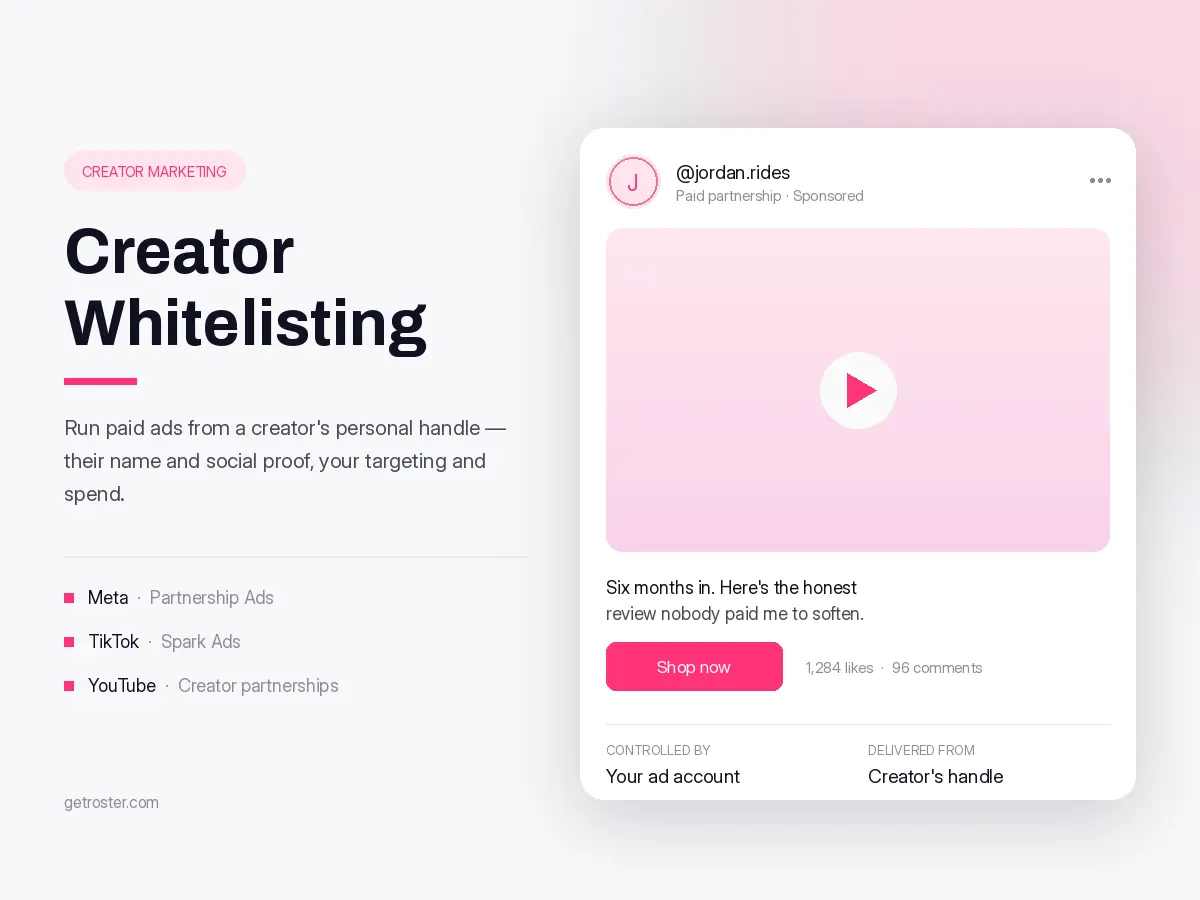
Creator whitelisting lets a brand run paid ads that appear to come from a creator’s personal handle instead of the brand account. The creator’s name, profile photo, follower count, and existing engagement stay attached to the ad. The brand controls targeting, budget, placements, and optimization.
The mechanic has been renamed more than once. You’ll see it called creator licensing, branded content ads, whitelisting, or handle-based ads. On the platforms themselves, the current terminology is:
- Meta (Instagram and Facebook) — Partnership Ads. This replaced the older Branded Content Ads flow. A creator grants your ad account permission, either through a partnership ad code or through an ongoing permission set in their account settings. You can promote an existing organic post, or run entirely new creative from the creator’s handle that never appeared on their grid.
- TikTok — Spark Ads. The creator generates an authorization code for a specific video, with a set duration. Your ad runs as that native post, and the engagement, comments, and follower attribution accrue to the original video.
- YouTube — creator partnership formats for Shorts and in-feed placements, run through Google Ads with creator permission.
Platform UI and naming change frequently, so treat the exact click path as something to confirm in the ad platform’s current help center before you write it into an SOP.
What it is not
- It’s not boosting. Boosting promotes an existing post with limited controls. Whitelisting gives you the full campaign structure — audiences, placements, objectives, creative testing — under the creator’s identity.
- It’s not the same as running UGC in your brand ads. UGC ads use creator-made content delivered from your handle. Whitelisted ads carry the creator’s handle and their social proof. Both are worth running, and the difference in performance between them is a test worth having in your account.
- It’s not a usage rights agreement. Ad permission and content license are two separate grants. More on that below, because it’s where most programs quietly create legal exposure.
Why ads from creator handles outperform brand-handle ads
There’s no shortage of trust statistics floating around this topic. The more useful explanation is structural, and it holds up in ad accounts:
The social proof travels with the ad. A whitelisted ad arrives with a real profile, a follower count, and — if you’re promoting an organic post — a comment section full of people who were not paid to be there. That context does work in the feed that a brand handle cannot manufacture.
It solves creative volume, not just creative quality. Broad-targeting and automated campaign types have shifted the main lever from audience selection to creative diversity. Accounts stall because they run out of distinct creative, not because they ran out of audiences. A roster of creators producing content monthly is a supply solution to a supply problem.
It slows creative fatigue. Ten variations of the same brand-shot video fatigue as one idea. Ten creators shooting in ten homes with ten voices fatigue independently, which extends the useful life of every winner.
The comparison is testable. Run the same creative from your handle and from the creator’s handle, split at the ad level, and you’ll have a brand-specific answer within a spend cycle. Some categories see a large lift, some see none. Don’t assume a category norm.
The three permissions you need (and the two most teams skip)
This is the part that separates a program you can scale from one your legal team eventually shuts down.
1. Ad permission
The platform-level grant that lets your ad account run under the creator’s handle. This is the easy one, and it’s the only one most brands actually collect. Note that it’s revocable, and on TikTok it expires with the authorization window — so a top performer can go dark mid-flight if nobody’s tracking expiry dates.
2. A paid media usage license
Ad permission does not give you rights to the content. A whitelisting agreement should specify the license term, the channels covered, whether you can edit or re-cut the footage, whether the license is exclusive within your category, and what happens to live ads when the term ends. It also needs to cover anyone else who appears in the video and any music used — creator-cleared audio for organic posting is frequently not cleared for paid media.
If you’re already running a program, the fix is to move rights collection into onboarding rather than negotiating it post by post. Handling it once, at signup, is the difference between whitelisting five creators and whitelisting fifty.
3. Disclosure
A whitelisted ad is a paid endorsement, and the FTC’s Endorsement Guides require that material connections between a brand and an endorser be disclosed clearly and conspicuously. The FTC’s Rule on Consumer Reviews and Testimonials, which carries civil penalties, raised the stakes further on testimonial content that misrepresents an independent relationship.
Platform tools help — the paid partnership label, TikTok’s branded content toggle — but the practical standard is whether an average viewer understands the relationship without hunting for it. Build the disclosure into the creative brief, not into a compliance review at the end. See the FTC’s Endorsement Guides for the current guidance.
How to run creator whitelisting at scale
Step 1: Source from people who already buy from you
The highest-performing whitelisted ads usually don’t come from marketplace hires. They come from customers, brand ambassadors, and creators who were already posting about the product before money changed hands. The content reads differently because the relationship is different, and the creator answers comments credibly because they actually use the thing.
Practically, that means your whitelisting pipeline starts inside your customer list. Brands with an existing ambassador program have a meaningful head start here: the recruitment, vetting, and rights conversations have already happened.
Step 2: Collect rights and ad permission at onboarding
Put the paid media license, the whitelisting permission, and the disclosure expectations into the application and agreement flow every creator signs when they join. One conversation, not fifty. This is also where you set the term — and where you set a calendar reminder for expiry.
Step 3: Let organic performance pick the creative
Don’t guess which content to put spend behind. Track what your creators are already posting and how it performs, then promote the pieces that earned attention without help. Organic engagement is an imperfect but cheap pre-test, and it costs you nothing to run. This is a good reason to have visibility into creator posts rather than relying on people to send you links.
Step 4: Structure the test properly
Whitelisted ads should enter your account as a creative test, not as a separate initiative with its own success criteria. That means:
- Same objective and audience structure as your control ads
- Split at the ad level so handle is the variable, not the campaign
- Enough spend per ad to clear the noise floor before you call it
- Judged on the same metric as everything else in the account, not on engagement rate
A whitelisted ad that wins on comments and loses on cost per acquisition is not a win.
Step 5: Attribute revenue to the creator, then pay accordingly
Ads Manager tells you which ad drove revenue. It does not tell you which creator relationship is worth renewing, because most creators are also posting organically, sending traffic through their own links, and generating sales that never touch a paid campaign. If you’re evaluating creators on whitelisted ad performance alone, you’re underpaying the ones who compound.
Give every creator a unique code and link so their organic contribution is measurable alongside their paid contribution, and roll both into one view of revenue per creator. That number is what should drive renewals, tier changes, and budget allocation.
What to measure
Four numbers make the case internally:
- Cost per acquisition, whitelisted vs. brand handle. Same creative, different handle. This is your headline comparison.
- Creative lifespan. How many days until frequency climbs and CPA degrades, compared to your brand-handle control. Longer runway is real money even when day-one CPA ties.
- Revenue per creator, paid plus organic. The renewal decision metric.
- Fully loaded cost per creator. Content fee, whitelisting fee, commission, product cost, and media spend in one place — otherwise the program looks cheaper than it is.
Blended CAC will move slowly and for many reasons at once, so don’t hang the program’s fate on it in month one. Creative-level comparisons give you a defensible read much faster.
Common mistakes
- Treating it as a one-off. Short engagements never reach the point where the creator understands the product well enough to make good content unprompted. Three to six month terms give you optimization room and compounding familiarity.
- Whitelisting one creator. One handle fatigues like one creative. The mechanic works because of portfolio breadth.
- Over-directing the creative. If the ad is scripted to sound like your brand, you’ve paid a premium for a brand ad with a stranger’s face on it.
- Letting permissions lapse silently. Expired authorization codes take live ads down without warning.
- Managing it in spreadsheets. Codes, rights terms, expiry dates, content links, and payouts across thirty creators is where the model breaks operationally, long before it breaks on performance.
Where Roster fits
The whitelisting itself happens inside Meta Ads Manager and TikTok Ads Manager — that’s the platform’s job, and no third-party tool replaces it. What Roster handles is everything on either side of the ad:
- Recruiting and vetting creators from your existing customer base through an application and program structure
- Collecting agreement terms and content rights at onboarding instead of post by post
- Tracking what creators post and how it performs, so you know what’s worth promoting
- Attributing sales to individual creators through codes and links
- Paying creators, including commissions, on a schedule that doesn’t require manual reconciliation
You can see the content side of this in practice in our UGC case study, and browse other programs in the customer case studies.
Key takeaways
- Creator whitelisting runs your ads from a creator’s handle, with their social proof attached — Partnership Ads on Meta, Spark Ads on TikTok
- Ad permission, content license, and disclosure are three separate things; collect all three at onboarding
- The real advantage is creative supply and slower fatigue, not a universal conversion lift — test it at the ad level
- Source from existing customers and ambassadors, not one-off marketplace hires
- Judge creators on total attributed revenue, paid and organic, not on whitelisted ad performance alone
FAQ
Is creator whitelisting the same as influencer marketing?
No. Influencer marketing is organic distribution to a creator’s existing audience. Whitelisting is paid amplification that borrows the creator’s identity to reach audiences you select. Most brands run both, and the same creator can do both.
Do creators lose control of their accounts?
No. The permission is scoped to running ads and does not grant access to post, message, or view account data. Creators can revoke it at any time, and on TikTok it expires automatically at the end of the authorization window.
What’s the difference between whitelisting and Spark Ads?
Spark Ads is TikTok’s implementation of the concept. Whitelisting is the general term; Spark Ads and Meta’s Partnership Ads are the platform-specific mechanics.
Do I need usage rights if I already have ad permission?
Yes. They’re separate grants. Ad permission lets you run the ad; the license governs what you’re allowed to do with the content, for how long, and on which channels. Get both in writing.
Does whitelisting work for prospecting or only retargeting?
Both, and the prospecting case is usually stronger — the creator’s credibility does the most work with people who have never heard of you.
How much should I pay for whitelisting rights?
It’s typically a separate fee from the content fee, priced against the license term and exclusivity rather than against follower count. Longer terms and category exclusivity cost more. Many brands running ambassador programs fold it into an ongoing agreement instead of pricing it per campaign.
How long should a whitelisting agreement last?
Three to six months is a common structure. It gives you enough runway to optimize, and it avoids renegotiating the moment something starts working.
How many creators do I need to start?
Five to ten gives you enough creative variation to see a signal. One or two will produce a result you can’t generalize from.
Run creator-led paid social without the manual overhead
Roster gives DTC brands one place to recruit creators from their customer base, collect rights and agreements at onboarding, track what those creators drive in revenue, and pay them for it. If your brand is doing $1M+ in revenue or has 10,000+ customers, book a 30-minute demo and we’ll walk through how brands structure creator programs that feed paid social. You can also see how Roster supports influencer and creator programs.