- Blog
- From $500 UGC Videos to $0: How DTC Brands Are Scaling Micro-Creator Content in 2026
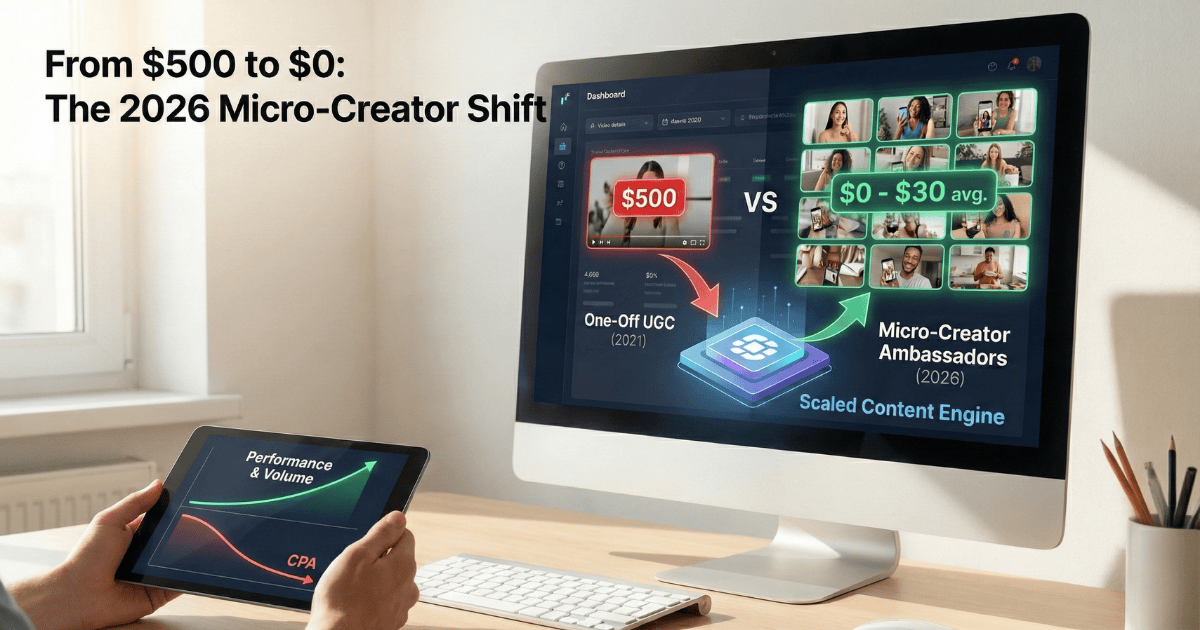


From $500 UGC Videos to $0: How DTC Brands Are Scaling Micro-Creator Content in 2026
You know that $500 UGC video your team commissioned last quarter — the one with the scripted testimonial, two rounds of revisions, and a creator who’d never actually used your product? It ran for eleven days before Meta’s algorithm buried it. Your CPA doubled. And somewhere in Slack, your paid media buyer quietly asked if you could “just try something different next time.”
That video was supposed to be the answer. Authentic content from real people, right? Except the whole UGC marketplace model — the one where you pay $200 to $500 per video to a stranger who films sixty seconds with your serum and moves on — stopped working the way it used to. Not because UGC stopped converting. Because the economy collapsed.
Here’s what changed: the average micro-creator UGC cost in 2026 has dropped to between $50 and $150 per asset for creators with fewer than 50,000 followers, according to data from Collabstr and Influence4You. Meanwhile, brands that run always-on ambassador programs are reporting content costs under $30 per video — sometimes $0 when the relationship is product-for-content. The $500 video isn’t just expensive anymore. It is an artifact of a model that DTC brands are actively abandoning.
And the performance gap is getting embarrassing. Micro-creator content is generating click-through rates up to 4x higher than polished brand creative and achieving cost-per-click reductions of 50% or more. These are not projections from a trend report — they are the numbers brands in our network are seeing right now.
Why Micro-Creators Are Winning: The Numbers Nobody Can Ignore
The influencer marketing industry hit $32.55 billion in 2026, according to Influencer Marketing Hub, growing at a 33% compound annual rate. But the money is not flowing where it used to. Seventy-three percent of brands now favor micro and mid-tier creators over celebrity and macro-influencer partnerships. That is a structural shift, not a trend.
Why? Because the engagement math is brutal for big accounts.
Nano-influencers — those with fewer than 10,000 followers — now make up 75.9% of Instagram’s influencer base and achieve engagement rates of 2.71%, roughly 50% higher than micro-influencers and dramatically above anyone with a blue checkmark and a million followers. Stack Influence’s January 2026 predictions report found that micro-influencers are nearly as popular with marketers as macro-influencers, at 74% versus 81% usage rates. But the real story is conversion: research compiled by Stack Influence showed nano- and micro-influencers achieving roughly double the sales conversion rate of macro-influencers — about 7% versus 3% of engagements converting to actual purchases.
So you can pay a macro-influencer $20,000 for a single post. Or you can activate fifty micro-creators at $400 each and generate more total engagement, more conversions, and a library of authentic content you actually own the rights to. The math does not require a spreadsheet to figure out.
There is something else happening here that the engagement data alone does not capture. Micro-creators produce content that looks like content — not ads. Their lighting is imperfect. Their scripts (when they have them) feel conversational. The product sits on a real bathroom counter, not a marble slab in a studio. And in a feed where 85% of advertisers now use AI for creative production, that imperfection is the entire point. Consumers have trained themselves to scroll past anything that looks too polished. The amateur aesthetic is not a limitation. It is the competitive advantage.
Impact.com’s 2026 trends report put it clearly: during Cyber Week 2025, influencer-driven spend jumped 51% while commission costs stayed flat. Creators are not just driving awareness anymore. They are closing sales. And 74% of brands are moving budget into creator programs in 2026 — not as experiments, but as a core acquisition strategy measured by the same CAC and ROAS standards as paid media.
One-Off UGC Deals Are Dead. Always-On Ambassador Programs Are What’s Replacing Them.
The marketplace model worked like this: you posted a brief, a creator accepted it, they filmed something in their apartment, you paid $300, and you never spoke again. Maybe the content performed. Maybe it sat in a Google Drive folder. Either way, the relationship ended at the transaction.
That model made sense in 2021 when UGC was novel, and the talent pool was small. It does not make sense when there are over 250,000 creators on platforms like JoinBrands alone, and the average UGC video price has been pushed down to $190 on Collabstr’s marketplace. Supply has exploded — UGC creator supply grew 93% year-over-year according to ClickAnalytic’s 2026 pricing data. The content itself is becoming commoditized.
But here is what has not been commoditized: genuine product knowledge. Real enthusiasm. The kind of content that comes from a creator who has used your moisturizer for three months, not three hours.
Influentials’ December 2025 trends report called it directly — “always-on creator programs replace one-off campaign bursts.” Their recommendation: budget per creator per month, not per individual post. Long-term ambassador programs supported by multi-tier rosters will outperform standalone collaborations. And the data from impact.com backs this up: gifted partnerships deliver 2.19% engagement rates, 12.9% higher than paid collaborations at 1.94%.
Think about what that means for your content calendar. Instead of scrambling to source four new creators every month, you build a roster of twenty to thirty micro-creators who know your product, understand your brand voice, and produce content on a predictable cadence. The content improves over time because the creators become product experts. They catch things in their fifth video that they missed in their first — the specific way your packaging opens, the texture detail that resonates on camera, the use case their audience asks about most.
This is not a theoretical argument. Brands on ambassador programs are reporting content costs that make the old marketplace model look absurd. When your ambassador creates content in exchange for free product and a modest monthly stipend — or even just product alone — your effective cost per video drops from $300 to under $30. Some brands in our network have pushed that number close to zero.
The Cost Math That’s Making CFOs Pay Attention
Let us get specific about micro-creator UGC costs, because ranges matter more than averages.
Influence4You’s 2026 survey data shows that creators with 5,000 to 10,000 followers charge an average of €110 per video (roughly $120). Creators with over 50,000 followers charge approximately €355 ($385). The overall market average sits around €180 ($195) per asset. But those are marketplace rates — meaning a one-off transaction with a stranger where you are also paying platform fees, usage rights add-ons (typically 30-50% extra), and possibly whitelisting fees on top.
Now compare that to the ambassador program economics. When you recruit micro-creators from your actual customer base — people who already bought and liked your product — the content exchange flips. Product-for-content deals (sometimes called “gifted collaborations”) eliminate the per-video cost entirely. You send a $30 product, they send back three videos. Your effective cost per asset: $10. That is not a typo.
And the performance side is what makes this genuinely interesting, not just cheap. Archive.com’s 2026 analysis found that UGC on product pages increases conversion rates by up to 8% through social proof, and that sites featuring UGC have 90% longer visitor sessions. Ketone-IQ, one of their case studies, achieved a 29% website revenue increase through shoppable UGC feeds. She’s Birdie saves $10,000 or more monthly on content creation alone.
Here is where it gets really compelling for paid media teams. The click-through rate advantage of micro-creator content over traditional brand creative runs as high as 4x in Meta and TikTok ad environments. Cost per click drops by 50% or more when you swap studio creative for authentic UGC in the same campaign structure. And because you are generating content at ten to twenty times the volume of the old model, you can test more hooks, more angles, more creators — and kill the losers fast without worrying about sunk production costs.
Brands that achieve an average $5.78 return for every dollar spent on influencer marketing are the norm, per Influencer Marketing Hub. Top-performing campaigns reach $11 to $18 ROI. That range is not achievable with a handful of $500 one-off videos. It requires volume, iteration, and the kind of systematic testing that only an always-on creator program can support.
Building the Machine: How to Scale Micro-Creator Content Without Scaling Your Team
So you are convinced the economics work. You want to move from one-off UGC purchases to an always-on ambassador program. The obvious question: who manages thirty micro-creators producing content every month? If you are a team of two — or even ten — that coordination overhead sounds like a full-time job you do not have budget for.
This is the problem we built GetRoster to solve.
What we have seen across our ambassador partners is that the bottleneck is never finding creators willing to make content. The bottleneck is the infrastructure: sourcing the right micro-creators from your existing customer base, onboarding them with brand guidelines that actually get followed, managing content delivery at a cadence that feeds your paid media team, and tracking which creators produce assets that convert versus ones that just look good on Instagram.
GetRoster turns your best customers into your content engine. Your ambassadors already know the product. They already have the social presence in your niche. And because the relationship is ongoing—not transactional—the content quality compounds over time rather than resetting with every new brief. Your content cost drops from $300 per video to under $30. Your creative library grows every week. And your paid team gets the volume of hooks and angles they need to test aggressively without blowing your production budget.
The brands running this model are not just saving money. They are outperforming their competitors on ROAS, building libraries of authentic content that work across paid ads, email, PDPs, and organic social, and creating a moat that no one-off UGC marketplace can replicate.
If that sounds like the direction you want to move, book a demo. We will show you exactly how the ambassador model maps to your current content volume and where the savings hit hardest.
Frequently Asked Questions
How much does micro-creator UGC cost in 2026?
Micro-creator UGC typically costs $50 to $150 per video for creators with under 50,000 followers on marketplace platforms. However, brands running ambassador programs report effective costs of $10 to $30 per asset — and sometimes $0 when the exchange is product-for-content. The key cost variable is not the creator’s rate but the relationship model you use.
What is the difference between a micro-creator and a UGC creator?
A UGC creator produces content for brands to use in their own ads and channels — they are paid for creative skill, not audience reach. A micro-creator (typically 1,000 to 100,000 followers) produces content and posts it to their own audience. Ambassador programs blur this line: your ambassadors create content you can repurpose AND post to their communities, giving you both licensed assets and organic distribution.
Do micro-creators actually drive sales or just awareness?
They drive sales. Research from Stack Influence found that nano- and micro-influencers achieve roughly double the sales conversion rate of macro-influencers—about 7% versus 3% of engagements converting to purchases. Impact.com reported that influencer-driven orders nearly doubled their share during Cyber Week 2025, with spend up 51% and commission costs flat.
How many micro-creators do I need for an always-on program?
Most DTC brands start with 15 to 30 active ambassadors and scale from there. The goal is a consistent content cadence — typically 30 to 60 new assets per month — rather than a specific headcount. The right number depends on how many product SKUs you are creating content for and how aggressively your paid team tests new creative.
Can I use micro-creator content in paid ads?
Yes, and you should. Micro-creator UGC consistently outperforms polished brand creative in paid environments, with click-through rates up to 4x higher and cost-per-click reductions of 50% or more. Make sure your ambassador agreements include ad usage rights — this is where most marketplace-sourced UGC becomes expensive, since ad licensing fees typically add 30 to 50% to the base rate.
What is the ROI of micro-influencer marketing compared to traditional ads?
Brands achieve an average $5.78 return for every dollar spent on influencer marketing, with top campaigns achieving an ROI of $11 to $18, according to Influencer Marketing Hub. By comparison, the average Meta ad ROAS for DTC brands in 2026 hovers around 2 to 3x. The gap widens further when you factor in the content repurposing value — a single ambassador video can run as a paid ad, land on a product page, go into email flows, and post organically.
How do I find micro-creators who are already customers?
Start with your post-purchase flow. Identify customers who tag your brand on social media, leave detailed reviews, or have active followings in your niche. Tools like GetRoster automate this by surfacing ambassadors from your existing customer base, scoring them by social presence and engagement, and streamlining the onboarding process so you are not manually DMing hundreds of people.
Sources
- Stack Influence 2026 Influencer Marketing Predictions — https://stackinfluence.com/2026-influencer-marketing-predictions/
- Influentials — Top 10 UGC and Influencer Marketing Trends for 2026 — https://www.influentials.com/blog/the-top-10-ugc-and-influencer-marketing-trends-every-brand-must-prepare-for-in-2026
- Impact.com — Influencer Marketing Trends 2026: Performance Insights — https://impact.com/influencer/influencer-marketing-trends-performance/
- Influence4You — UGC Video Pricing in 2026 — https://blogen.influence4you.com/ugc-video-pricing-in-2026-how-much-should-you-pay-content-creators/
- Influencer Marketing Hub — 14 Influencer Marketing Growth Statistics for 2026 — https://archive.com/blog/influencer-marketing-growth-statistics
- ClickAnalytic — Influencer Price List: What Brands Pay Per Post in 2026 — https://www.clickanalytic.com/influencer-price-list/
- Archive.com — 20 UGC Content Creation Time Savings Statistics for 2026 — https://archive.com/blog/ugc-content-creation-time-savings-statistics
- Collabstr — UGC Creator Price Calculator (2026 data) — https://collabstr.com/influencer-price-calculator/user-generated-content
9. Influencer Marketing Hub — Micro Influencer Rates for 2026 — https://influencermarketinghub.com/micro-influencer-rates/