- Blog
- DTC Customer Acquisition Cost 2026: The Ambassador Infrastructure Shift
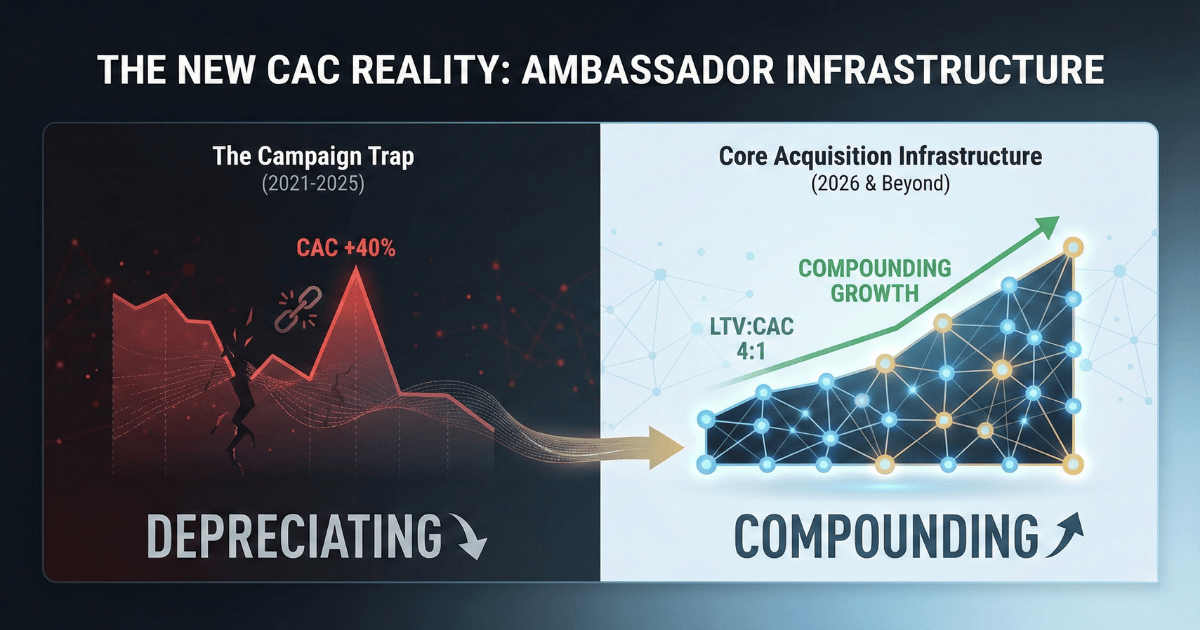


DTC Customer Acquisition Cost 2026: The Ambassador Infrastructure Shift
Your paid ROAS just dipped below 2x again. Your CFO is circling the CAC line on every monthly report. And somewhere in your Slack, a growth lead just posted a screenshot of CPMs that look like they belong in a luxury auction house.
Welcome to 2026, where the median DTC brand is spending $130-156 to acquire a single customer, CAC has climbed 40% in just two years, and the old math of “pour money into Meta, watch revenue grow” has fully and irreversibly broken down. The brands that figured this out early aren’t scrambling. They’ve already rebuilt. And what they built looks nothing like a marketing campaign.
This is the story of how the smartest DTC operators are turning ambassador programs from a line item in the social budget into core acquisition infrastructure. Not because it’s trendy. Because the DTC customer acquisition cost 2026 reality leaves them no other option.
The Growth-at-All-Costs Era Died. Most Brands Haven’t Buried It Yet.
Go back five years. A DTC founder could raise a seed round, dump 70% of it into Facebook ads, and watch a hockey stick appear in their Shopify dashboard. The targeting was surgical. The CPMs were reasonable. And nobody asked hard questions about unit economics because the top line kept climbing.
That world is gone.
Apple’s ATT framework gutted cross-app tracking in 2021, and only about 25% of consumers opted into being tracked afterward. Cookie deprecation continued rolling across browsers. The precision targeting that made $20 CAC possible simply stopped existing. Simultaneously, competition intensified. Established retail brands adopted DTC tactics, bringing superior brand recognition to the same ad auctions. Amazon and retail marketplaces captured more ecommerce share. And every new DTC brand that launched added another bidder to the same shrinking pool of targetable audiences.
The result: CAC has surged roughly 60% over the past five years according to multiple industry analyses. Ecommerce brands now lose an average of $29 on every first-time customer they acquire. And 88% of subscription-based DTC brands report higher acquisition costs compared to last year.
This isn’t a correction. It’s a structural shift. The brands still running the 2019 playbook aren’t just behind. They’re burning cash into a model that gets more expensive with every passing quarter.
Why Campaigns Don’t Compound (and Why That’s the Whole Problem)
Here is the core issue with treating ambassador programs as campaigns. Campaigns have a shelf life. You run one, it performs or it doesn’t, and then it’s over. The budget resets. The creative goes stale. You start from zero again next quarter.
Infrastructure compounds.
Think about it this way. A paid Meta campaign might deliver a 2.1x ROAS this month. Next month, you need fresh creative, fresh budget, and probably higher CPMs to reach the same audience. Nothing you spent last month reduces what you spend next month. It’s a treadmill, and the speed keeps increasing.
An ambassador program works differently. An ambassador who joins in January and creates 10-15 pieces of content per month builds a library by July that performs across paid, organic, email, and product pages simultaneously. The cost of that content drops over time because the relationship deepens, the ambassador’s product knowledge grows, and their audience engagement increases. Referred customers from ambassador networks retain 37% longer and deliver 16% higher lifetime value than paid-acquired customers, according to Wharton Business School research. Word-of-mouth marketing generates almost five times more sales than paid advertising, with nearly 13% of all consumer sales driven by WOM.
That compounding is the difference between a channel and infrastructure. A channel delivers results while you’re spending. Infrastructure delivers results that build on themselves.
The Infrastructure Mindset: How Winning Brands Think About Ambassadors Differently
The DTC brands pulling ahead in 2026 aren’t slotting ambassador programs into their influencer marketing budget. They’re rebuilding their org charts around them.
What that looks like in practice:
Reporting changes. Ambassador program performance reports to the VP of Growth or CMO, not the social media manager. The metrics are acquisition economics (CAC, LTV:CAC ratio, payback period) not vanity metrics (impressions, likes, follower count).
Budget allocation shifts. Instead of allocating 80% to paid and 20% to “organic and community,” winning brands are moving toward 50/50 splits or even heavier weighting toward owned channels. With 63% of DTC brands now tracking CAC as their top KPI according to DTC trend reports, the budget follows the math.
Team ownership evolves. Managing 15-50 ambassadors across briefs, content approvals, performance tracking, and payments isn’t a side project for an intern. Brands are creating dedicated ambassador operations roles, similar to how they previously built out dedicated paid media teams. The operational infrastructure matters as much as the creative output.
Success metrics get real. Campaign thinking measures reach and engagement. Infrastructure thinking measures cost per acquired customer through the ambassador channel, LTV of ambassador-referred customers versus paid-acquired customers, content cost per performing asset (ambassador content typically runs 1/10th of marketplace UGC rates at scale), and payback period on ambassador program investment.
This isn’t a philosophical shift. It’s a financial one. When your paid CAC hits $150 and your ambassador-referred CAC is running 30-50% lower, the reallocation conversation stops being optional.
The Compounding Effect: Why Ambassador Programs Get More Valuable Over Time
Most marketing channels depreciate. Creative fatigues. Audiences saturate. CPMs inflate. You spend more to get less, quarter after quarter.
Ambassador programs run in the opposite direction.
In months one through three, you’re in setup mode. Recruiting 10-15 ambassadors from your actual customer base, establishing content cadences, and starting to collect performance data. The CAC advantage is modest but visible. Video testimonials from ambassadors achieve 1.5-2x lower CAC than static ads right from the start.
By month six, you have a functioning content engine. Each ambassador’s output has improved because they know the product better, they’ve learned what resonates with their audience, and they’ve built a genuine narrative around your brand. Your content library has grown to hundreds of assets. The cost per performing piece has dropped to under $30, roughly a tenth of marketplace rates.
By month twelve, the compounding kicks in visibly. Your ambassador network has expanded through referrals (ambassadors recruit ambassadors). The content library is deep enough to fuel A/B testing across every channel. Referred customers are referring their own networks, creating second and third-order acquisition loops. And your data on what works is mature enough to optimize the entire funnel.
Bain and Company research shows a 5% increase in customer retention can boost profitability by 25-95%. Ambassador programs deliver that retention improvement structurally, because customers acquired through trusted recommendations start with higher loyalty than customers acquired through interruptive ads.
92% of consumers trust recommendations from people they know directly. No amount of ad spend purchases that kind of trust. You build it. And once built, it compounds.
How GetRoster Turns Ambassador Programs Into Acquisition Infrastructure
This is where theory meets operational reality. Most brands understand the ambassador math. They believe in the model. But managing ambassador relationships at scale through spreadsheets and Slack threads collapses by week three.
What we’ve built at GetRoster is the infrastructure layer that makes compounding possible. Your team owns the strategy and the relationships. GetRoster handles the operational backbone: matching you with ambassadors from your actual customer base, managing content production at cadence, tracking performance down to the individual creative level, and keeping payments clean.
The distinction matters because infrastructure requires systems, not heroics. A marketing manager can run a 5-person ambassador campaign manually. They cannot run a 50-person ambassador program that produces 400 pieces of content per month, tracks attribution across six channels, and manages tiered compensation without dedicated tooling. That’s not a productivity problem. It’s an architecture problem.
For DTC brands looking at the 2026 numbers and recognizing that their DTC customer acquisition cost 2026 trajectory is unsustainable, GetRoster represents the fastest path from campaign thinking to infrastructure thinking. Not a tool bolted onto your existing workflow. A system designed from the ground up for the brands that treat ambassadors as what they actually are: their most efficient, most scalable, most defensible acquisition channel.
Book a demo and we’ll show you the math for your specific brand.
Frequently Asked Questions
What is a good DTC customer acquisition cost in 2026?
Current benchmarks place average ecommerce CAC between $50 and $156, depending on the category. But the more useful metric is your LTV:CAC ratio. Most sustainable DTC businesses aim for 3:1 or 4:1. Anything below that signals an acquisition model that won’t survive another year of rising CPMs. Brands running ambassador programs typically see 30-50% lower CAC than those relying purely on paid channels.
How much has DTC customer acquisition cost increased recently?
CAC has risen approximately 40% in the past two years and roughly 60% over the past five years. The drivers are structural: platform saturation, loss of third-party tracking data post-iOS 14.5, more brands competing for the same inventory, and rising CPMs across Meta, Google, and TikTok. This is not a temporary spike.
What is the difference between a campaign and acquisition infrastructure?
A campaign is a time-bound initiative with a start date, end date, and fixed budget. Acquisition infrastructure is a permanent, compounding system that gets more efficient over time. Ambassador programs function as infrastructure because the content library grows, ambassador product knowledge deepens, and referred customers create second-order acquisition loops. Campaigns reset to zero. Infrastructure builds on itself.
How do ambassador programs reduce customer acquisition cost?
Ambassadors produce authentic content at a fraction of marketplace UGC rates (roughly 1/10th at scale). That content performs across paid, organic, email, and product pages simultaneously. Referred customers cost 30-50% less to acquire than paid-channel customers and deliver 16% higher lifetime value according to Wharton research. The compounding creative library means your cost per performing asset drops every month.
How long does it take to see ROI from ambassador infrastructure?
Budget 8-12 weeks to recruit your first cohort, establish content cadences, and collect initial performance data. By month three, you should have a functioning content engine with measurable CAC advantages over paid channels. By month six, the compounding effect becomes clearly visible in your economics. By month twelve, most brands see ambassador-sourced acquisition as their highest-ROI channel.
Can small DTC brands build ambassador acquisition infrastructure?
Yes, and often more effectively than large brands. Smaller brands typically have more passionate customer bases and higher engagement rates. Start with 5-10 ambassadors recruited from your actual repeat purchasers. The per-ambassador cost is manageable even on tight budgets, and the authentic content they create frequently outperforms professional creative because it carries genuine enthusiasm rather than produced polish.
Why is the LTV:CAC ratio more important than CAC alone?
A $150 CAC is catastrophic if your LTV is $200 and sustainable if your LTV is $600. The ratio captures both sides of the equation: what you spend and what you earn back. Ambassador-referred customers typically deliver 16% higher LTV and 37% longer retention, which means even a slightly lower CAC becomes dramatically more efficient when factored against the revenue those customers generate over 12-24 months.
Sources
- Mobiloud — Average Customer Acquisition Cost for Ecommerce (2026 Benchmarks) — https://www.mobiloud.com/blog/average-customer-acquisition-cost-for-ecommerce
- First Page Sage — Average CAC for eCommerce Companies: 2026 Edition — https://firstpagesage.com/reports/average-cac-for-ecommerce-companies/
- Admetrics — Marketing Trends 2026: Essential Strategies for DTC Ecommerce — https://www.admetrics.io/en/post/marketing-trends-2026-dtc-ecommerce-70307
- Avenue Z — Top DTC and Ecommerce Marketing Predictions for 2026 — https://avenuez.com/blog/top-dtc-and-ecommerce-marketing-predictions-for-2026/
- L.E.K. Consulting — Fighting Rising Direct-to-Consumer Customer Acquisition Costs — https://www.lek.com/insights/con/us/ei/fighting-rising-direct-consumer-customer-acquisition-costs
- Wharton Business School (via GetAmbassador) — Word-of-Mouth Marketing Statistics — https://getambassador.com/blog/word-of-mouth-marketing-statistics/
- Bain & Company (via WiserReview) — 24 Impactful Word-of-Mouth Marketing Stats (2026) — https://wiserreview.com/blog/word-of-mouth-marketing-stats/
- eMarketer — FAQ on Direct-to-Consumer Commerce: How to Make D2C Profitable in 2026 — https://www.emarketer.com/content/faq-on-direct-to-consumer-commerce-how-make-d2c-profitable-2026
- Venture Media — DTC Trends 2025: Key Industry Shifts — https://www.venturemedia.io/post/dtc-trends-2025
10. Shopify — Word-of-Mouth Marketing: The Ultimate Guide for 2026 — https://www.shopify.com/blog/what-is-word-of-mouth-marketing