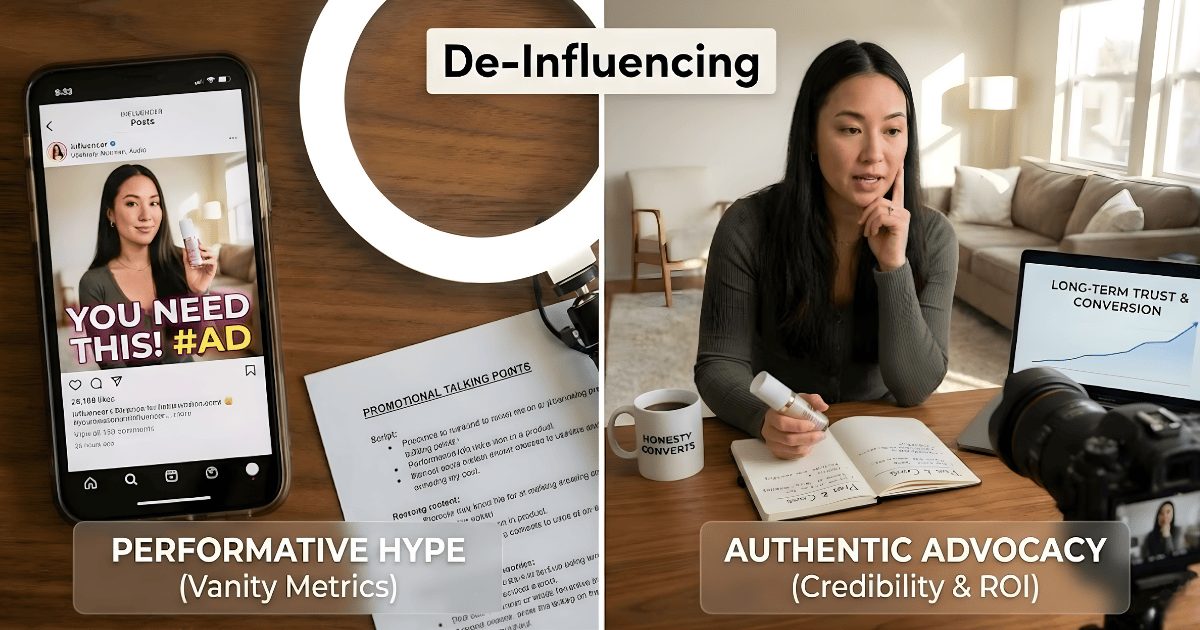
What Is De-Influencing?
De-influencing is the creator-led pushback against performative, overly promotional content.
Instead of saying “You need this,” creators are saying:
- “You don’t need this unless…”
- “Here’s what I liked—and what I didn’t”
- “This worked for me, but it might not for you”
At first glance, this feels risky for brands. In reality, it’s the most important shift in modern commerce.
Because paradoxically—honesty converts better than hype.
Why Consumers Stopped Trusting Traditional Influencer Marketing
For years, influencer marketing optimized for the wrong things:
- Follower count
- Aesthetic polish
- Scripted endorsements
The result? Audiences got smarter—and more skeptical.
According to Harvard Business Review, 95% of purchasing decisions are made subconsciously, driven by trust, emotion, and social proof—not rational ad claims.
Source: HBR — https://hbr.org/2015/01/the-new-science-of-customer-emotions
When content feels forced, audiences don’t just ignore it—they actively distrust it.
Human truth: People don’t mind being influenced.
They mind being sold to.
Why Authenticity Outperforms Every Other Metric
De-influencing works because it restores credibility.
Research from McKinsey shows that word-of-mouth influences 20–50% of all purchasing decisions, making peer trust the most powerful driver of conversion across industries.
Source: McKinsey — https://www.mckinsey.com/business-functions/marketing-and-sales/our-insights/the-science-behind-the-effectiveness-of-word-of-mouth
Authentic creator content:
- Reduces perceived risk
- Feels like advice, not advertising
- Creates belief before intent
This is why peer-led recommendations convert 3–5× higher than website or paid ad traffic, according to Shopify.
Source: Shopify — https://www.shopify.com/research/word-of-mouth-marketing
SEO takeaway: Google rewards content people trust.
Business takeaway: Trust drives revenue faster than reach.
What De-Influencing Means for DTC Brands
De-influencing doesn’t mean creators are anti-brand.
It means brands must earn advocacy instead of scripting it.
According to Bain & Company, advocacy-led brands achieve 1.6× higher profit margins than brands dependent on performance advertising alone.
Source: Bain — https://www.bain.com/insights/the-value-of-wowing-your-customers/
For DTC teams, this signals a clear shift:
- From one-off influencer posts → long-term ambassadors
- From controlled messaging → creator autonomy
- From vanity metrics → downstream impact
Marketing implication: Authenticity isn’t a creative style—it’s a strategy.
Business impact: Lower CAC, higher CLV, stronger brand equity.
How to Build for Authenticity at Scale
1. Stop Over-Briefing Creators
The fastest way to kill authenticity is over-direction.
High-performing brands:
- Share product context, not scripts
- Encourage pros and cons
- Let creators speak in their own voice
According to Harvard Business Review, brands that cultivate ambassador-style relationships outperform transactional influencer programs with 9.2% higher ROI per campaign.
Source: HBR — https://hbr.org/2022/03/does-influencer-marketing-really-pay-off
2. Reward Honesty, Not Hype
Creators who are honest build more trust—even when they point out limitations.
Brands that embrace this see stronger long-term performance because audiences believe the positives more when negatives are acknowledged.
Human insight: Credibility compounds.
3. Build Long-Term Creator Relationships
De-influencing thrives in continuity.
According to Shopify, long-term ambassador partnerships deliver 11× higher ROI than one-off influencer campaigns because trust compounds over time.
Source: Shopify — https://www.shopify.com/research/influencer-marketing-roi
Ambassadors:
- Learn the product deeply
- Speak naturally about it
- Normalize buying without pressure
4. Measure What Actually Matters
If authenticity is the strategy, metrics must evolve.
Track:
- Assisted conversions
- Repeat purchase influence
- Content reuse performance
- Ambassador lifetime value
Brands emphasizing trust-based advocacy improve profitability margins by up to 30% versus high-CPA ad models, according to McKinsey.
Source: McKinsey — https://www.mckinsey.com/capabilities/growth-marketing-and-sales/our-insights
Key Takeaways
- De-influencing is a trust reset—not a trend
- Authenticity now outperforms reach, CPMs, and polish
- Honest creators drive stronger long-term conversion
- The future of influencer marketing is credibility-first
FAQ
Is de-influencing bad for brands?
No. It’s bad for hype-driven brands—but great for quality products and long-term growth.
Should brands allow creators to share negatives?
Yes. Balanced reviews increase credibility and overall conversion.
Does authenticity work at scale?
Yes—when powered by ambassadors and long-term creator relationships.
What replaces traditional influencer KPIs?
Revenue influence, repeat purchases, content reuse performance, and CLV.
Ready to build an influencer strategy audiences actually trust?
Book a demo with Roster and see how DTC brands shift from performative influence to authentic advocacy—powered by ambassadors, attribution, and long-term community growth.