A brand ambassador has an ongoing relationship with your brand and is usually paid on performance. An influencer is engaged for a campaign and paid a flat fee for agreed deliverables.
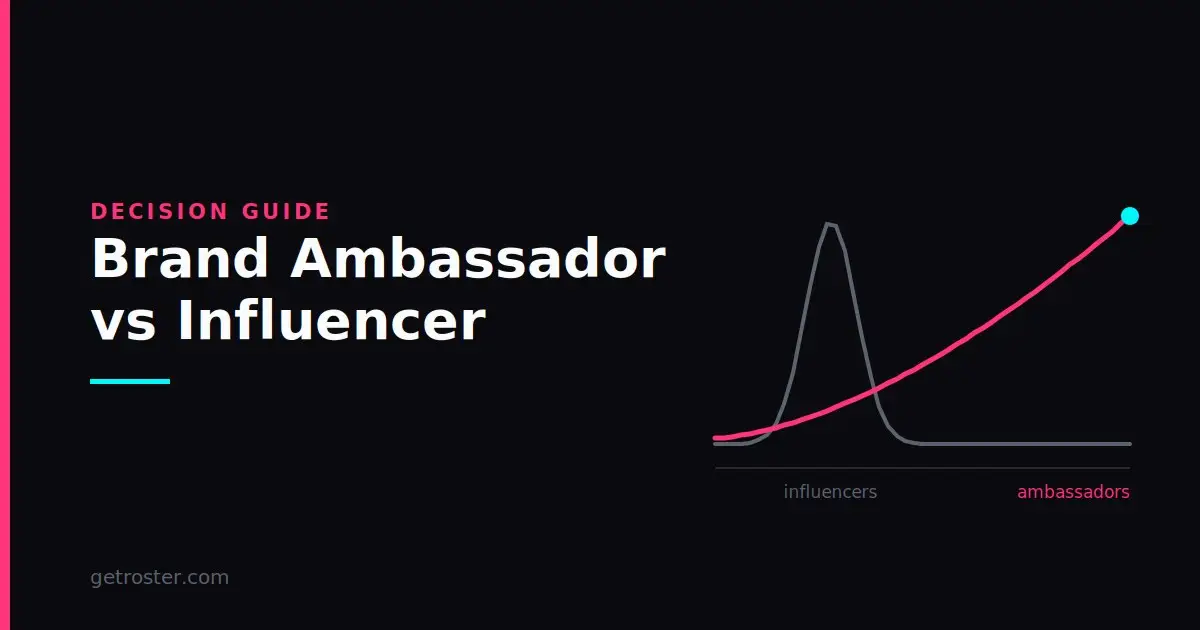
That distinction is easy and mostly unhelpful. The decision that actually matters is what you are buying: ambassadors buy compounding content and revenue at variable cost, influencers buy predictable reach at fixed cost. Which is right depends on whether you have a date to hit or a channel to build.
The difference that decides the budget
|
Brand ambassador |
Influencer |
| Relationship |
Ongoing, months to years |
Campaign-based, often one-off |
| Compensation |
Commission, product, or tiered |
Flat fee per deliverable |
| Cost predictability |
Variable, tied to performance |
Fixed and known upfront |
| Who bears the risk |
Mostly the ambassador |
Entirely you |
| Typical audience size |
Micro and nano |
Mid-tier to macro |
| Content volume |
High, spread over time |
Concentrated in a campaign window |
| Product familiarity |
Usually a real customer |
Often introduced for the campaign |
| What you own after |
A relationship and a content library |
Whatever the contract licensed |
| Best for |
Compounding content and revenue |
Launches and reach spikes |
The row that decides most budgets is risk. With an influencer you pay before you know whether it worked. With an ambassador you mostly pay after. That single difference is why ambassador programs survive budget cuts and influencer line items rarely do.
Which should your brand use?
Use ambassadors if
You need sustained content volume, your margin supports commission, and you have an existing customer base to recruit from. Ambassador programs compound — fifty people producing content monthly outperforms fifty one-off posts, and cost per asset falls as the program matures rather than resetting with each campaign.
Use influencers if
You have a launch date, a fixed budget, and need guaranteed reach inside a defined window. You are buying certainty, and certainty costs more. For a launch with a hard date, that premium is usually worth paying.
Use both, in this order
Build the ambassador program first because it is cheaper, compounding, and doubles as a discovery mechanism for which creators actually convert your audience. Then use paid campaigns for launches and seasonal pushes. Running influencer campaigns without an ambassador program underneath means paying full price for every piece of content, indefinitely.
The cost comparison brands get wrong
Influencer campaigns look expensive on the invoice and are often cheaper per asset in month one. Ambassador programs look cheap on the invoice and carry costs that never appear there.
Forgotten on the ambassador side: COGS on seeded product that never produces a post, the margin given up on audience discount codes, and coordination time that scales with program size. A 15% commission plus a 15% code is 30% off the order before COGS.
Forgotten on the influencer side: you own the relationship for exactly as long as you are paying for it, and usage rights you didn’t negotiate upfront cost multiples to acquire later.
The honest framing: ambassadors trade upfront certainty for lower long-run cost per asset. Influencers trade long-run efficiency for a guaranteed outcome on a date. Neither is cheaper in the abstract, and any comparison run over a single campaign will flatter influencers while any comparison run over a year will flatter ambassadors.
Where affiliates and UGC creators fit
Two adjacent roles that get folded into this comparison and shouldn’t be.
Affiliates are paid purely on attributed sales, typically with no product relationship and no content obligation. Where ambassadors are curated, affiliates are usually open-enrolment and managed at scale. If your goal is attribution and payout rather than content, that is a different tool and a different program.
UGC creators produce content for you to use in your own channels and are paid per asset. Many never post to their own audience at all — you are buying production, not distribution. If your bottleneck is content volume for paid social rather than reach, this is often cheaper than either ambassadors or influencers.
The practical test: are you short of reach, short of content, or short of attributed revenue? Each points at a different answer, and brands that skip the question buy the wrong one.
Converting influencers into ambassadors
The most efficient version of this is not choosing between the two. An influencer who performed on a paid campaign has already proven their audience converts for your product — which is exactly the evidence an ambassador program is otherwise designed to generate slowly and expensively.
- Track attributed revenue by creator on every paid campaign, not just reach and engagement. Most brands never do this and so have nothing to act on when the campaign ends.
- At campaign close, offer the top performers an ongoing commission arrangement.
- Give them a permanent code and link so the relationship keeps earning after the budget stops.
- Place them in your top tier immediately. They have already demonstrated what entry-tier ambassadors take months to prove.
Disclosure applies to both
The FTC’s Endorsement Guides require disclosure wherever a material connection exists, and responsibility sits with the brand. Free product counts, whether or not a post was required — so ambassador programs are not exempt because nobody was paid cash. Build it into your terms and your brand kit. General guidance, not legal advice.
Frequently asked questions
What is the difference between a brand ambassador and an influencer?
A brand ambassador has an ongoing relationship and is usually compensated on performance through commission or product. An influencer is engaged for a specific campaign and paid a flat fee for agreed deliverables.
Are brand ambassadors cheaper than influencers?
Lower upfront cost, but not automatically cheaper. Ambassador programs carry product cost, audience discount margin, and coordination time that never appear on an invoice. They typically win on cost per asset over a year, not in month one.
Can someone be both?
Yes, and it is often the best outcome. Brands frequently run a paid campaign with a creator, then move whoever drove attributed revenue into an ongoing ambassador arrangement.
Which drives more sales for ecommerce brands?
Ambassadors usually drive more attributed revenue across a full year because content compounds and repeated recommendation carries more weight than a single post. Influencers drive more inside a campaign window. The right comparison is annual, not per-campaign.
Do brand ambassadors need to disclose?
Yes. Free product is a material connection under the FTC’s Endorsement Guides whether or not a post was required, and responsibility for disclosure sits with the brand.
How do I decide which to start with?
If you have customers who already post about you, start with ambassadors — the recruiting is nearly free and the economics are performance-based. If you have a launch date and no existing advocate base, run a paid campaign first and convert the performers. Our program template covers the ambassador setup end to end.