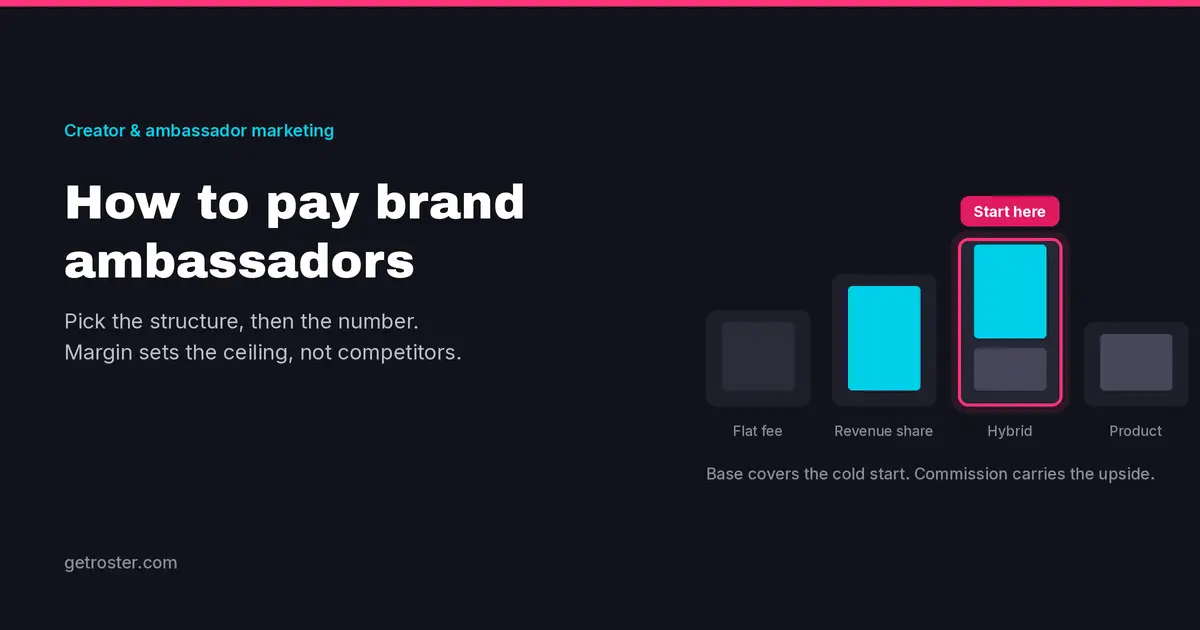
There is no single right rate. There is a right structure, and it depends on what you need the person to do — post, sell, or stay.
Most brands get this backwards. They pick a number first, usually by copying whatever a competitor pays, then discover the model is rewarding the wrong behaviour: flat fees that buy content nobody can attribute, or commissions so small that the people driving real revenue drift to a brand that pays properly.
This covers the four models, what each one does to behaviour, how to set the actual number, and the admin that catches brands out at scale.
Match the model to the job
| Model | Best for | What it does to behaviour |
|---|
Revenue share
commission on tracked sales |
Ambassadors and affiliates whose job is selling |
Aligns spend with outcome and costs nothing when it doesn't work. Slow to start — new ambassadors may earn nothing for weeks, which is when most quit. |
Flat fee
paid per deliverable |
Specific content you need on a date |
Guarantees the asset. Buys no ongoing relationship, and the cost per asset never falls. |
Hybrid
small base plus commission |
Most ambassador programs past the first cohort |
Covers the early gap so people stay long enough to earn, while keeping upside tied to performance. The default worth starting from. |
Non-cash
product, credit, access |
Customer ambassadors and early-stage programs |
Cheap at COGS rather than retail, and genuinely motivating for people who already like the brand. Stops working once someone is driving real revenue. |
Revenue share
The cleanest model, and the one that scales without a budget conversation every quarter: the channel pays for itself by construction. Its weakness is the cold start. Someone who joins, posts twice and earns nothing has no reason to post a third time — which is why pure commission programs tend to show a sharp drop-off in month two.
Flat fees
Use them strategically rather than systemically. A flat fee is the right instrument when you need a specific asset — a launch video, a particular format, content on a deadline — and the wrong one as the backbone of a program, because you're buying deliverables rather than building a relationship. Every flat fee is a cost that repeats identically next quarter.
The hybrid model
A modest base — product, a small monthly retainer, or a guaranteed minimum for the first 60 days — plus commission on everything tracked. The base solves the cold-start problem; the commission means your best people can earn well above it without you renegotiating.
The base should be small enough that commission is clearly the larger opportunity. If someone can earn comfortably without selling anything, you've built a content retainer with extra steps.
Non-cash incentives
Product, account credit, early access, and exposure all cost you less than their perceived value, and for customer ambassadors they often motivate more than a small commission would. They're the natural fit for seeded creators and the entry tier of a program.
The limit is firm: once someone is driving meaningful revenue, product stops being compensation and starts being an insult. Move them onto commission before they notice.
How to set the actual number
Work from your margin, not from what a competitor pays.
- Start with contribution margin per order, not gross revenue. Commission comes out of margin, so that's the pool you're dividing.
- Set your ceiling at what you'd pay for the same customer elsewhere. If paid acquisition costs you $130 per buyer, a commission that lands well under that is a good trade even at a rate that feels high in percentage terms.
- Decide first-order versus lifetime. Paying on first order only is simpler and cheaper. Paying on repeat orders for a defined window costs more and produces dramatically more effort from the people who can drive retention.
- Check it against the code discount. A 15% ambassador commission stacked on a 15% audience discount is 30% off margin before shipping. Model the combined number, not each separately.
- Build in a tier ceiling. Rates should rise with contribution, which is what a tier structure is for — but decide the top rate before anyone reaches it.
If you're budgeting a program from scratch, what an ambassador program costs covers the platform and management side alongside the payouts.
Attribution decides whether any of this works
Every model except flat fees depends on knowing who drove what. Without per-person tracking you end up paying flat fees by default, because it's the only thing you can administer — which is how brands end up with the most expensive model by accident rather than by choice.
The minimum is a unique code and a unique link per ambassador, consistently applied, with the person's name attached to both. That single piece of infrastructure is what makes revenue share, hybrid, and tiering possible at all. The wider framework sits in measuring program ROI.
The admin nobody plans for
Payment structure is a finance problem as much as a marketing one, and it's usually the thing that stalls a program at scale rather than the rate itself.
- Payout frequency. Monthly is standard. Quarterly saves admin and costs you people — the feedback loop gets too long to feel like a response to anything.
- Minimum thresholds. A $25 or $50 floor prevents dozens of tiny transfers, but set it too high and small ambassadors never get paid at all, which is worse than paying them nothing by design.
- Tax reporting. In the US, commission paid to individuals is reportable income and you'll need tax details on file before the first payout, not after. Collect them at onboarding — chasing a W-9 from someone who earned $80 eleven months ago is a genuinely miserable job.
- International payouts. Currency, fees, and method vary by country. Decide whether you're paying non-US ambassadors before you recruit them.
General guidance, not tax or legal advice — confirm reporting thresholds with your accountant.
Paying someone creates a disclosure obligation
Commission, flat fees, product, and credit are all material connections under US rules, and disclosure is required on the post. The responsibility sits with the brand as well as the creator, so "we told them to" isn't a defence if nobody checks.
Put the requirement in the program terms and the campaign brief rather than in a separate policy document. The FTC's endorsement guides Q&A covers the common cases in plain language, its guidance for brands sets out where responsibility sits, and the underlying rules are in 16 CFR Part 255.
What to do if you're starting from nothing
A defensible default for a first program:
- Entry tier — product and a tracked code. No cash. This is where seeded creators and new customer ambassadors sit.
- Active tier — commission on tracked sales, rate set from contribution margin, paid monthly.
- Top tier — higher commission plus non-cash access that a competitor can't match: early product, a private group, input on launches.
- Flat fees — reserved for specific assets you need on a date, priced per deliverable, outside the tier system entirely.
Then leave it alone for a quarter. Changing rates repeatedly teaches ambassadors to wait for a better offer. If participation is the problem rather than the rate, that's an engagement problem and paying more won't fix it. The full build is in the program template, and if you're still deciding which kind of program to run, ambassadors versus affiliates covers that choice.
Structure the pay, then automate it. Roster handles tiers, commission rates, tracked codes and payouts in one place — so you can run a hybrid model without reconciling spreadsheets every month.
Book a demo →
Frequently asked questions
How much should I pay brand ambassadors?
Work from contribution margin per order rather than from competitor rates, and cap it below what the same customer would cost you through paid acquisition. Model the commission together with any audience discount the ambassador offers — the two stack against the same margin.
Is commission or a flat fee better for ambassadors?
Commission for anyone whose job is driving sales, because it ties cost to outcome. Flat fees for specific content you need on a date. Most programs past their first cohort do best on a hybrid: a small base that covers the early weeks, plus commission with real upside.
What is a hybrid payment model?
A modest base — product, a small retainer, or a guaranteed minimum for an initial period — combined with ongoing commission on tracked sales. The base solves the cold start that causes new ambassadors to quit before earning anything; the commission keeps the upside tied to performance.
Can I pay ambassadors in product instead of cash?
Yes, and for entry-tier and customer ambassadors it often motivates more than a small commission would, at a cost to you of COGS rather than retail. Move people onto commission once they're driving meaningful revenue — product stops reading as compensation at that point.
How often should I pay ambassadors?
Monthly. Quarterly payouts save administrative work and cost you participation, because the gap between the effort and the reward becomes too long to feel connected.
Do I need to report ambassador payments for tax?
In the US, commission paid to individuals is reportable income and you'll need their tax details on file before the first payout. Collect them at onboarding rather than chasing them at year end. Confirm the current thresholds with your accountant.
Do ambassadors have to disclose that they're paid?
Yes. Commission, flat fees, free product and credit are all material connections requiring clear disclosure on the post, and the obligation extends to the brand as well as the creator. Put it in the program terms and check that it's being followed.