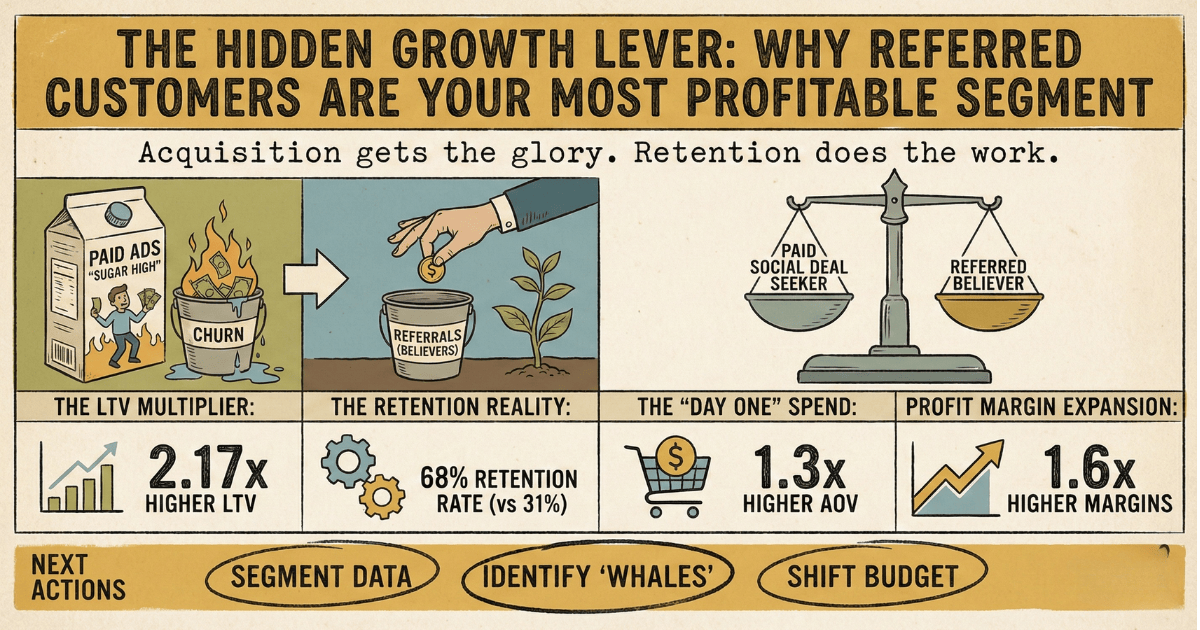
In the world of e-commerce, “Acquisition” gets all the glory. “Retention” does all the work.
Most brands are addicted to the “Sugar High” of new customer acquisition. They burn cash on Meta and TikTok ads to bring new people in the front door, ignoring the fact that these customers often churn out the back door before they ever become profitable.
If you are looking at your unit economics and wondering why your LTV (Lifetime Value) is flatlining despite higher ad spend, here is the hard truth: You are acquiring the wrong customers.
Data confirms that customers who arrive via referrals (ambassadors, friends, community) behave fundamentally differently than those who arrive via ads. They don’t just stay longer, they are mathematically superior in almost every metric that matters to your bottom line.
Here is the unit economics breakdown of why referred customers are the hidden lever for profitable growth.
1. The LTV Multiplier: Quality Over Quantity
The “Growth at All Costs” era taught us to value every email address equally. That was a mistake.
When you buy a customer on Paid Social (Facebook/Instagram), you are often acquiring a “deal seeker” or impulse buyer. When you acquire a customer through an ambassador referral, you are acquiring a “believer.”
The difference in Lifetime Value is staggering. According to Roster client data and industry benchmarks, the LTV of referred traffic is 2.17x higher than that of Paid Social traffic.
Even more dramatic findings from Shopify research show that referral customers acquired via peer sharing generate 10x the lifetime value of standard first-time buyers.
The Executive Takeaway: One referred customer is worth two (or even ten) paid ad customers. If you want to double your revenue, you don’t necessarily need double the traffic—you just need traffic that actually sticks.
2. The Retention Reality: Fixing the Leaky Bucket
Churn is the silent killer of growth. If you have to replace 50% of your customer base every year just to stay flat, you don’t have a growth problem; you have a retention problem.
Referral programs act as a natural filter for high-retention customers. Because these buyers are pre-qualified by a peer they trust, they arrive with higher intent and “stickiness.”
The data proves it:
- Retention Rate: Referred customers have a 68% retention rate, compared to just 31% for Paid Social.
- Duration: On average, referred customers retain 37% longer than non-referred customers.
When you shift your mix toward advocacy, you stop filling a leaky bucket. You start building a fortress.
3. The “Day One” Spend: Higher AOV
There is a common myth that referral programs are just about handing out discounts. The fear is that this lowers the Average Order Value (AOV).
The math says the opposite happens.
Because referred customers arrive with “Social Proof”—the psychological assurance that the product is good because a friend said so—they are less hesitant to spend.
- Paid Social AOV: Baseline.
- Referral AOV: 1.25x to 1.30x higher.
They buy more on Day One, and they keep buying longer. This creates a compounding effect on your cash flow efficiency.
4. The Profit Margin Expansion
Ultimately, the CFO cares about one thing: Margin.
Paid ads are a tax on your margin. As CPMs rise, your profit per unit sold shrinks. Advocacy reverses this pressure. By offloading the acquisition cost to your community (rewarding them only after a sale is made), you protect your downside.
Bain’s analysis reveals that advocacy-led brands earn 1.6x higher profit margins than their competitors. Furthermore, Deloitte found that these programs deliver up to 24% lower customer acquisition costs (CAC).
Lower costs + Higher LTV = A healthier business.
The Executive Verdict
If your growth strategy is 100% dependent on renting attention from Big Tech, you are vulnerable. You are acquiring low-LTV customers at high-CAC prices.
The “Hidden Growth Lever” isn’t a new ad hack or a magic copy script. It is shifting your focus to the source of your customers.
By building an ambassador program, you aren’t just getting “free marketing.” You are systematically recruiting your most profitable, loyal, and high-value customer segment.
Here are your next 3 actions:
- Segment Your Data: Go into your Shopify/BigCommerce analytics right now. Compare the LTV of customers who used a referral code vs. those who came from a Facebook ad. The gap will validate this strategy immediately.
- Identify “Whales”: Look for customers with 3+ repeat purchases. These are your highest potential ambassadors. They are already loyal; you just haven’t armed them with a referral link yet.
Shift the Budget: Take 5-10% of your lowest-performing ad spend and reallocate it to funding ambassador rewards. You will be trading low-margin views for high-margin retention.